Human-AI Teaming for COVID-19 Response: A Practice & Research Collaboration Case Study
A reflexive case study of the 6-month NSF RAPID project in which researchers from three universities, emergency-management practitioners and 120 volunteers built and used a human-AI social-media monitoring system (CitizenHelper) for the Washington D.C. region during COVID-19. It names job-related and timescale challenges of practice–research collaboration and offers eight best practices.
The practice–research divide in disaster management
Organizational: sustaining a researcher–practitioner–volunteer AI collaboration
Problem
Practitioners and researchers have different incentives (solve problems now vs. publish), processes (IRB review, academic calendars) and timescales. The “research–practice divide” often prevents disaster-research partnerships from forming or lasting.
Approach
- Case: the human-AI teaming workflow (Fig. 1), first designed in 2018: practitioner-defined keywords → CitizenHelper real-time Twitter collection for the National Capital Region → volunteers label relevance, risk and prevention behavior, and sentiment → hierarchical classifiers (relevance F1 0.73 / AUC 0.88; behavior F1 0.81 / AUC 0.77, from Mining Risk Behaviors from Social Media for Pandemic Crisis Preparedness and Response). In parallel, 61 Zoom think-aloud interviews with volunteers.
- Method: participant observation and reflexivity, informed by weekly team meetings, presentations and joint grant writing.
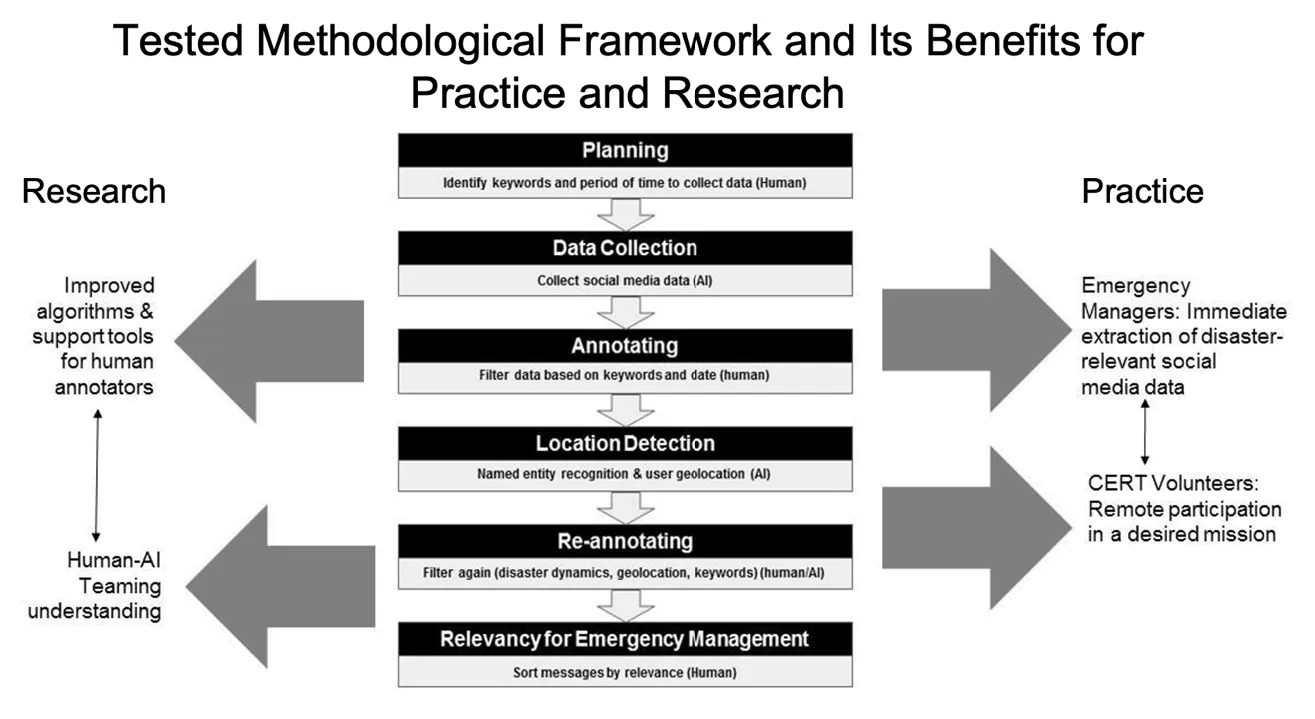 Fig. 1: Planning → data collection (AI) → annotating (human) → location detection (AI) → re-annotating (human/AI) → relevancy sorting (human), with benefits to research and practice.Figure from Hughes et al., ISCRAM 2022.
Key findings
- Job-related challenges:
- Process differences: IRB delays (eased because the pandemic was slow-moving and the relationship pre-existed), academic calendars and student turnover, and unpredictable funding. These were handled with a fluid team of four core researchers.
- Equal partnership: shared decisions, visible partnership with volunteers, rotating first authorship (including the practitioner).
- Timescale challenges:
- Helping now vs. future understanding: fast fixes from interview feedback, e.g. a profanity filter that replaces swear words with “[swear word]” and improved labelling-interface navigation, built by the system engineers.
- Reporting progress: thank-you videos; briefings at FEMA’s COVID-19 Crowdsourcing Unit meetings (8 weeks) and to the White House OSTP and NIH (Dec 2020).
- Engagement: weekly meetings, on-call technical staff, celebrations, challenge coins.
- Eight best practices: early relationship building, workflow continuity, shared recognition, continual communication, team-building, joint public communication, real-time feedback, and sharing insights.
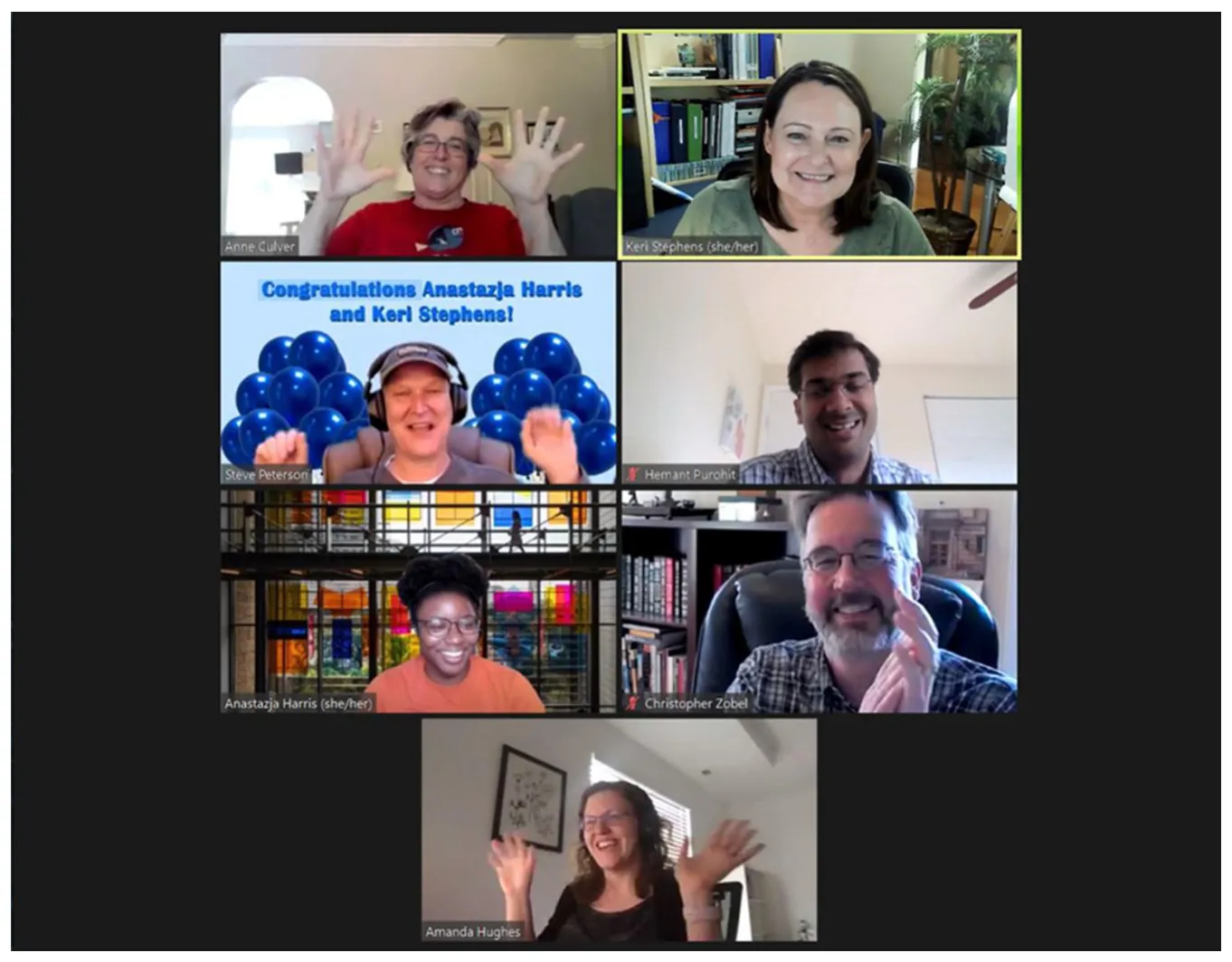 Fig. 2: The project team celebrating over Zoom.Figure from Hughes et al., ISCRAM 2022.
Cite this paper
Hughes, A., Stephens, K. K., Peterson, S., Purohit, H., Harris, A. G., Senarath, Y., Jarvis, S. A., Montagnolo, C. E., Nader, K. (2022). Human-AI Teaming for COVID-19 Response: A Practice & Research Collaboration Case Study. ISCRAM 2022 Conference Proceedings --- 19th International Conference on Information Systems for Crisis Response and Management (ISCRAM).
@inproceedings{Hughes2022,
  author    = {Hughes, A and Stephens, Keri K and Peterson, Steve and Purohit, Hemant and Harris, Anastazja G and Senarath, Yasas and Jarvis, S Ashley and Montagnolo, Carolyn E and Nader, Karim},
  booktitle = {ISCRAM 2022 Conference Proceedings --- 19th International Conference on Information Systems for Crisis Response and Management (ISCRAM)},
  title     = {Human-{AI} Teaming for {COVID}-19 Response: A Practice \& Research Collaboration Case Study},
  year      = {2022},
  keywords  = {Conference,Collaboration},
  url       = {https://idl.iscram.org/files/amandahughes/2022/2470_AmandaHughes_etal2022.pdf}
}