Mining Risk Behaviors from Social Media for Pandemic Crisis Preparedness and Response
With eight Community Emergency Response Teams (CERTs) in the Washington D.C. area, the authors defined a risk-preventing vs. risk-taking behavior schema for COVID-19 tweets. Volunteers labelled 13.6k tweets, and a hierarchical classifier (relevance, then multi-label behavior) filters the stream with relevance AUC 0.88 and behavior micro-F1 0.81.
City services need to see public risk-taking and risk-preventing behavior
Hierarchical multi-label classification of a new behavior schema on data with modest agreement
Problem
Most social-media crisis research covers natural hazards, not pandemics. City emergency services need to know whether the public is following or undermining protective measures (masks, distancing), because behavior drives mobility and their resource needs. No schema or dataset existed for this.
Approach
- Schema (with a certified emergency manager and CERTs): Risk-preventing (supports measures such as masks and distancing), Risk-taking (undermines them), or Irrelevant. Prevention and Risk can co-occur (Table 1).
- Data: about 2.1M geo-fenced D.C.-metro tweets (Mar–May 2020), filtered with 1,521 CERT-curated keywords. 14k sampled; 39 CERT volunteers labelled 13,584. Each tweet has at least 2 annotators, and an emergency manager adjudicated relevance disagreements.
- Agreement: Cohen’s κ 0.64 for relevance and 0.53 for Prevention and for Risk; percent agreement 89–90% (Table 2). Hard even for trained humans.
- Framework (Fig. 2): stream → relevance classifier → multi-label behavior classifier → dashboard.
- Features: tf-idf (M1), mean 200-d GloVe (M2), both combined (M3). LR and linear SVM, one-vs-rest for multi-label, stratified 10-fold CV.
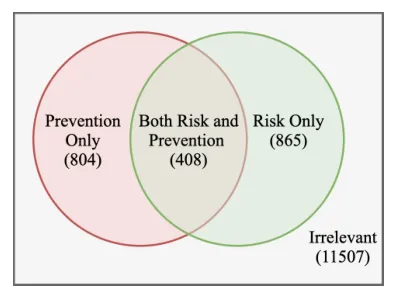 Fig. 1: 804 Prevention-only, 865 Risk-only, 408 both, 11,507 irrelevant.Figure from Senarath et al., SBP-BRiMS 2021.
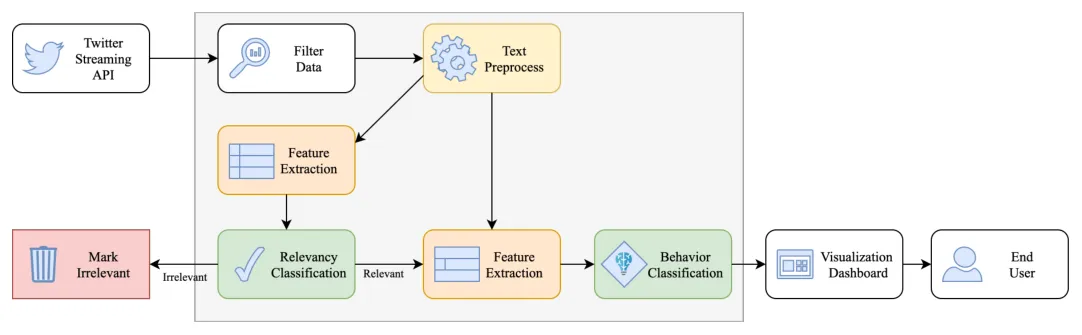 Fig. 2: Twitter stream → filtering and preprocessing → relevance classification → behavior classification → visualization dashboard.Figure from Senarath et al., SBP-BRiMS 2021.
Key results
- Relevance (Table 3): tf-idf works best. LR M1 reaches F1 0.73, AUC 0.88; embeddings alone give F1 0.55. Corpus-specific lexical cues separate irrelevant content well.
- Behavior (Table 4): combining features helps. LR M3 reaches micro-F1 0.81, AUC 0.77; Risk F1 0.82, Prevention F1 0.79.
- Logistic regression beats SVM on both tasks. Keeping stopwords helps behavior classification (AUC 0.76 vs. 0.74).
- Error analysis (Table 5): the hybrid model catches implicit prevention (e.g., “keeping a healthy distance at the Arboretum”) that tf-idf misses.
Contributions
- A novel, practitioner-defined risk-behavior schema for pandemic social-media content.
- A labelled dataset created with CERT volunteers.
- A classification framework that rapidly filters social streams for risk behaviors for city emergency services.
Limitations & future work
- Few relevant examples for training deep models; few modelling schemes tried.
- Future: more labels, deep learning, psycholinguistic features, unsupervised pattern discovery.
Cite this paper
Senarath, Y., Peterson, S., Purohit, H., Hughes, A. L., Stephens, K. K. (2021). Mining Risk Behaviors from Social Media for Pandemic Crisis Preparedness and Response. Proceedings of the 2021 International Conference on Social Computing, Behavioral-Cultural Modeling, & Prediction and Behavior Representation in Modeling and Simulation (SBP-BRiMS).
@inproceedings{Senarath2021b,
  author    = {Senarath, Yasas and Peterson, Steve and Purohit, Hemant and Hughes, Amanda L and Stephens, Keri K},
  booktitle = {Proceedings of the 2021 International Conference on Social Computing, Behavioral-Cultural Modeling, \& Prediction and Behavior Representation in Modeling and Simulation (SBP-BRiMS)},
  title     = {Mining Risk Behaviors from Social Media for Pandemic Crisis Preparedness and Response},
  year      = {2021},
  keywords  = {Conference,first,Resilience},
  url       = {https://sbp-brims.org/2021/papers/working-papers/2021_SBP-BRiMS_FinalPDF_55.pdf}
}