Online-Computer-Mediated Interviews and Observations: Overcoming Challenges and Establishing Best Practices in a Human-AI Teaming Context
A methods paper from the COVID-19 human-AI teaming project. Researchers ran more than 50 Zoom interviews with screen sharing while volunteer annotators labelled tweets in the lab's annotation platform. It documents five challenges specific to fully online research: researchers acting as help desks, privacy leaks, missing context, harder think-aloud, and panoptic observation effects. It also offers best practices and two training videos.
Studying human-AI annotation work remotely during COVID
Methodological: screen-shared, multi-session mediated observation
Problem
COVID-19 moved qualitative research online, but method guidance barely covered screen-shared observation or repeated interviews with the same participant.
- RQ1: what challenges arise in synchronous, fully mediated research with multiple interviews?
- RQ2: how can the lessons be turned into training for other researchers?
Approach
- Setting: 14 Virtual Emergency Response Team (VERT) volunteers and their manager. Volunteers labelled COVID-19 tweets in an online annotation platform while researchers observed via Zoom (Table 1). Volunteers were paid $25/h for three one-hour sessions.
- Data collection: five researchers from three universities, usually two per session; Calendly scheduling; semi-structured interviews with a think-aloud protocol; IRB approved.
- Analysis: weekly team meetings for 8 weeks, field notes and recordings, constant comparative analysis into core categories.
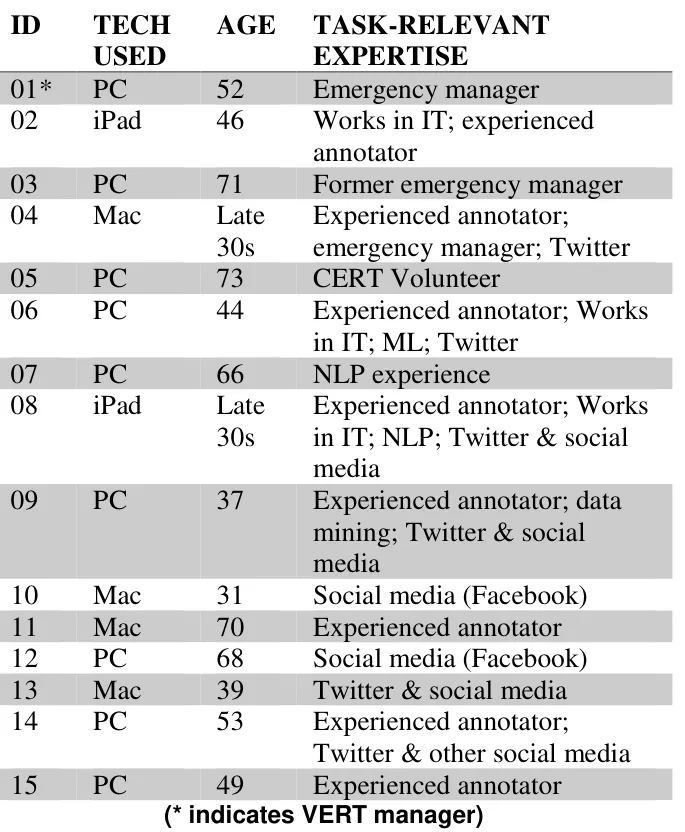 Table 1: The 15 participants: device, age and task-relevant expertise.Figure from Stephens et al., HICSS 2021.
Key results
- Challenges confirmed from the literature: technical issues, technology competence, rapport, distractions, and giving feedback.
- Five new challenges:
- Researchers as real-time help desks. Institutional Zoom settings differed, iPad vs. desktop screen-share buttons have different names, bandwidth drops (one participant was bumped seven times), and lost annotation-platform passwords or links.
- Privacy. Names appear in recordings; personal email and texts surface during screen sharing; household members are captured.
- Missing context. Weather and bandwidth at the participant’s end are invisible, as are printed label guides on desks.
- Think-aloud is harder. Face-to-face video makes participants treat the researcher as a collaborator and seek affirmation.
- Observation (panoptic) effects. Self-view prompts self-consciousness, while screen sharing hides the observer.
- Theory: supports cues-filtered-out theory, but also Walther’s hyperpersonal model: repeated sessions built strong relationships (follow-up emails, LinkedIn invites). It also highlights technology affordances: the “same” Zoom behaves differently across users.
- Practical output: two training videos for researchers doing mediated studies.
Contributions
- Method guidance for fully mediated, screen-shared, multi-session research.
- Theoretical extensions (cues-filtered-out, hyperpersonal model, surveillance, affordances).
- Training videos for the IS research community.
Cite this paper
Stephens, K., Nader, K., Harris, A., Montagnolo, C., Hughes, A., Stevens, A., Wijesuriya, Y. P. S., Purohit, H. (2021). Online-Computer-Mediated Interviews and Observations: Overcoming Challenges and Establishing Best Practices in a Human-Ai Teaming Context. Proceedings of the 54th Hawaii International Conference on System Sciences (HICSS).
@inproceedings{Stephens2021,
  author    = {Stephens, Keri and Nader, Karim and Harris, Anastazja and Montagnolo, Caroline and Hughes, Amanda and Stevens, Ashley and Wijesuriya, Yasas Pramuditha Senarath and Purohit, Hemant},
  title     = {Online-Computer-Mediated Interviews and Observations: Overcoming Challenges and Establishing Best Practices in a Human-Ai Teaming Context},
  year      = {2021},
  booktitle = {Proceedings of the 54th Hawaii International Conference on System Sciences (HICSS)},
  keywords  = {Conference,Collaboration},
  url       = {https://scholarspace.manoa.hawaii.edu/items/c5d4d5bc-c5e6-4427-ace9-21547815b545}
}