Eliciting Socio-Technical Research Needs on Countering Violence-Inducing and Hateful Speech in Cyberspace
The main SOCYTI journal paper. A participatory-design study of Norwegian hate-speech victims (survey, n = 71) and responders (25 people from 20 organizations) identifies four needs: emotional support, awareness, legal clarity and technology. These feed a conceptual multilingual, multimodal AI framework for hate-speech investigation and prevention: detection, exploration, social network analysis and trend monitoring, an ontology and knowledge graph, continual model adaptation and explainable AI, under explicit legal and ethical safeguards.
Victims and responders need support against online hate
Designing a responsible multilingual, multimodal detection framework
Problem
Online hate speech harms individuals and community cohesion. It is ambiguous, culturally specific and evolving; only about 7% of content is hateful; labelled data is mostly English; and moderation tools ignore stakeholders’ needs and rights. Norwegian context and data are especially scarce.
Approach
- Theory: Stakeholder theory, participatory design, socio-technical theory, and the NIST AI Risk Management Framework.
- Methods (Fig. 1): the SOCYTI social-science team ran a victim survey (about 300 reached, 71 responses; purposive and snowball sampling through advocacy groups) and responder workshops (2) and interviews (20) with 25 individuals from 20 organizations (municipalities, Konfliktrådet, NGOs, police, a NATO advisor).
- Framework (Fig. 3):
- questionnaires and interviews → stakeholder needs → legal and ethical considerations → ontology;
- scenarios: data collection → detecting types of malicious speech → context analysis and exploration analysis → social network analysis and trend monitoring → evidence and preventive action.
- Scenarios: (1) HS investigation: detection and exploration, gathering evidence for case assessment by humans. (2) HS prevention: detection and context analysis (SNA, event-linked trends, heat maps) to target interventions.
- Technical components:
- transformer-based binary and multiclass detection;
- target labels: potentially hateful, offensive or abusive, and neutral;
- 15k English/Norwegian tweets collected, with 1,500 expert-labelled and the rest weakly labelled;
- plans for Mastodon, Bluesky and Reddit data, and multimodal data;
- SNA with community detection;
- an ontology-guided knowledge graph queried with SPARQL or natural language;
- continual adaptation (drift detection with DDM/EDDM, defenses against catastrophic forgetting);
- XAI (SHAP, LIME);
- human-in-the-loop review, GDPR, EU AI Act, ethical and data-protection impact assessments.
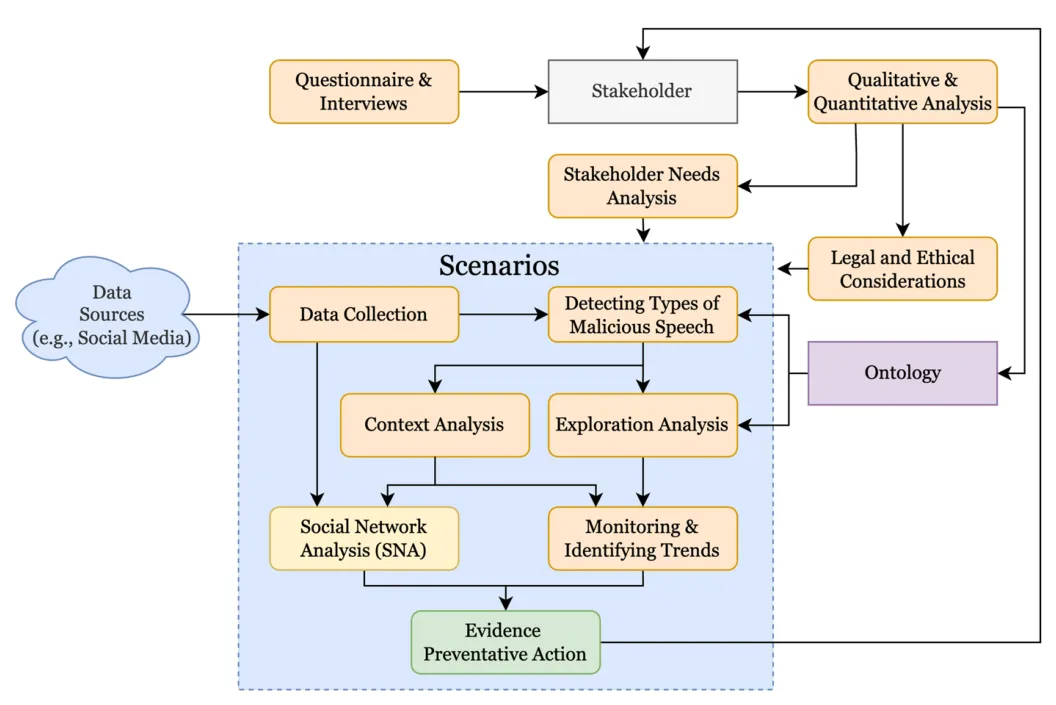 Fig. 3: Stakeholder inputs → needs and legal/ethical analysis → ontology → scenario pipeline (data collection → detection → context and exploration analysis → SNA and trend monitoring → evidence and preventive action).Figure from Vella et al., Digital Society 2025.
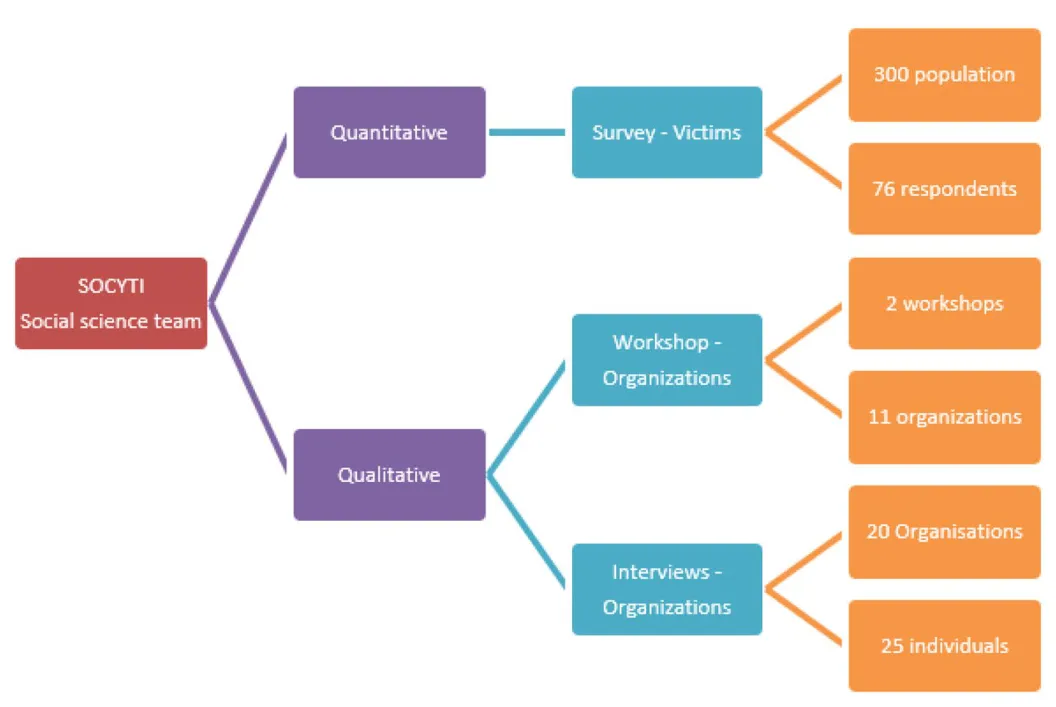 Fig. 1: SOCYTI social-science team: quantitative victim survey (76 respondents shown in the figure; 71 in the text) and qualitative workshops and interviews with organizations.Figure from Vella et al., Digital Society 2025.
Key findings (stakeholder needs)
- Emotional and psychological support (Fig. 2): victims reported anger (43), fear (29), violation (28), shame (27), humiliation (15) and pride in identity (13). Only 25% got help from friends and family, and 14.6% from support groups. Front-line responders from minority backgrounds face secondary trauma.
- Awareness: 41 respondents knew of no resources; only 3 knew of legal resources.
- Legal and institutional: only 2 respondents (3%) got help from police. Norway’s §185 is vague; platform moderation is retreating (Meta, X).
- Technology: responders are overwhelmed by volume and need ML-assisted monitoring; victims need easier reporting.
Contributions
- A holistic conceptual framework for countering online hate speech grounded in participatory stakeholder-needs analysis.
- Two scenario paths (prevention, investigation) and their components, plus legal and ethical safeguards for deployment.
Limitations
- Small, self-selected survey sample (n = 71, highly educated, engaged with support networks).
- Conceptual: the system is still being built; no detection results are reported.
Cite this paper
Della Vella, D., Senarath, Y., Hashmi, E., Abomhara, M., Shaikh, S., Igland, T., Dralega, C. A., Yayilgan, S. Y., Purohit, H., Akerkar, R. (2025). Eliciting Socio-Technical Research Needs on Countering Violence-Inducing and Hateful Speech in Cyberspace. Digital Society 4(2), 62.
@article{DellaVella2025,
  author    = {Della Vella, Dante and Senarath, Yasas and Hashmi, Ehtesham and Abomhara, Mohamed and Shaikh, Sarang and Igland, Torborg and Dralega, Carol Azungi and Yayilgan, Sule Yildirim and Purohit, Hemant and Akerkar, Rajendra},
  journal   = {Digital Society},
  title     = {Eliciting Socio-Technical Research Needs on Countering Violence-Inducing and Hateful Speech in Cyberspace},
  year      = {2025},
  number    = {2},
  pages     = {62},
  volume    = {4},
  keywords  = {Journal,Resilience},
  publisher = {Springer International Publishing Cham},
  url       = {https://link.springer.com/article/10.1007/s44206-025-00212-8}
}