Lifelong Learning Framework for Multilingual Hate Speech Detection in Social Media Streams
The paper frames hate-speech detection as a lifelong learning problem over a stream of (topic, language) tasks. A multilingual transformer with an LB-SOINN replay memory keeps performance across past tasks better than batch or online fine-tuning: best average F1 on 7 of 10 tasks, e.g. task 2 at 0.63 vs. 0.51 / 0.54.
Hate speech shifts to new topics and languages
Learning a task stream without catastrophic forgetting
Problem
Hate speech changes with world events: new targets and topics appear, and it is posted in many languages. Static models trained on fixed topics or one language degrade. Naively updating them causes catastrophic forgetting. No prior work combined lifelong learning with multilingual hate-speech detection.
Approach
- Problem: a task τ(t, l) is binary hate detection for topic t in language l. Tasks arrive in sequence, and after each one the model is evaluated on the current and all past tasks (Figs. 1–2).
- Task-stream simulation: BERTopic (multilingual sentence encoder, UMAP, HDBSCAN; 8 topics, at least 50 documents each) assigns topics. (Topic, language) groups are ordered by size, giving 10 tasks.
- Data: the MLMA multilingual hate-speech tweets, English and French, binarized (any non-normal label counts as hateful). French tweets are machine-translated to English to balance topics.
- Model (Fig. 3):
- Learning component: a pre-trained multilingual language-model encoder plus a linear head, fine-tuned with AdamW on cross-entropy plus a memory replay loss.
- Memory component: LB-SOINN (load-balancing self-organizing incremental neural network) keeps the most important instances from past tasks.
- Baselines: batch learning (an independent model per task) and online learning (sequential fine-tuning without forgetting prevention). Learning rate 1e-5, batch size 8, 10 epochs with early stopping.
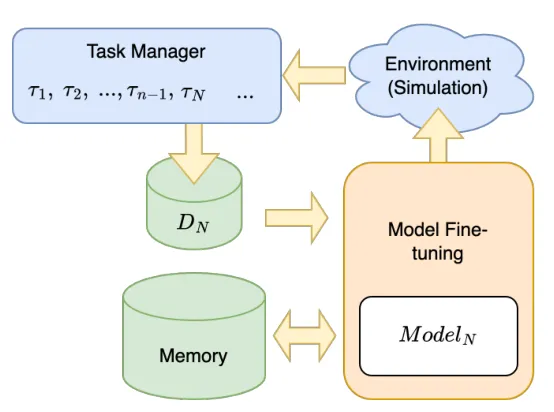 Fig. 3: Task manager → dataset D_N → fine-tuning with memory replay → model N.Figure from Senarath et al., SBP-BRiMS 2024.
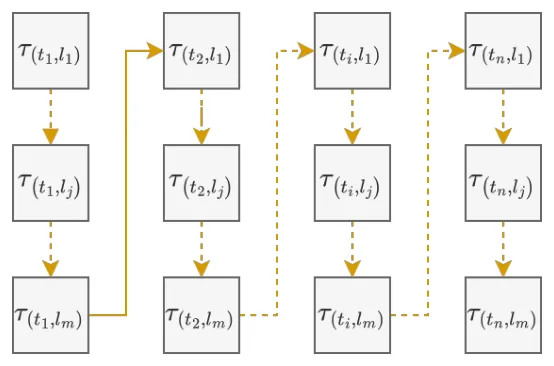 Fig. 2: Tasks ordered by topic, with all languages for a topic arriving together.Figure from Senarath et al., SBP-BRiMS 2024.
Key results
- Across tasks (Table 2, Fig. 4): lifelong learning has the best average F1 on 7 of 10 tasks (task 6 is a tie), e.g. tasks 1–4: 0.53 / 0.63 / 0.60 / 0.52 vs. batch 0.47 / 0.51 / 0.49 / 0.44. The baselines degrade toward the end of the stream.
- Outlier: task 7 collapses to F1 0.06 but recovers after task 8 (same topic, other language), a sign of possible cross-lingual transfer.
- On the newest task only (Fig. 5): batch 0.51 > lifelong 0.48 > online 0.42. A dedicated per-task model wins on the new task, but lifelong learning keeps past tasks without retraining.
Contributions
- A new problem formulation: multilingual lifelong hate-speech detection over a topic and language task stream.
- A method combining a multilingual pre-trained encoder with an LB-SOINN memory against forgetting.
- Evaluation on a bilingual (English/French) dataset against batch and online baselines.
Future work
- More languages and topics; semi-supervised learning for largely unlabelled streams.
Cite this paper
Senarath, Y., Purohit, H. (2024). Lifelong Learning Framework for Multilingual Hate Speech Detection in Social Media Streams. Proceedings of the 17th International Conference on Social Computing, Behavioral-Cultural Modeling, & Prediction and Behavior Representation in Modeling and Simulation (SBP-BRiMS).
@inproceedings{Senarath2024b,
  author    = {Senarath, Yasas and Purohit, Hemant},
  booktitle = {Proceedings of the 17th International Conference on Social Computing, Behavioral-Cultural Modeling, \& Prediction and Behavior Representation in Modeling and Simulation (SBP-BRiMS)},
  title     = {Lifelong Learning Framework for Multilingual Hate Speech Detection in Social Media Streams},
  year      = {2024},
  keywords  = {Conference,first,Continual},
  url       = {https://sbp-brims.org/2024/papers/working-papers/Wijesuriya_SBP-BRiMS2024_Final_42.pdf}
}