Knowledge-guided Continual Learning for Behavioral Analytics Systems
Replay-based continual learning is limited by a small memory buffer. This paper augments both the incoming task data (before exemplar selection) and the replayed exemplars (before learning) using the crowd-sourced Wiktionary knowledge graph, with a "semantic" mode that substitutes only senses relevant to hate. Across three hate-speech datasets it greatly improves final accuracy (e.g., HateXplain 16.7% → 46.7%) and nearly eliminates forgetting.
Behavior classifiers degrade as online discourse drifts
A fixed replay buffer limits continual learning; how and where to inject external knowledge
Problem
Online behaviors such as hate speech drift as events and targets change (e.g., anti-Asian hate during COVID). Fine-tuned classifiers degrade, and updating them causes catastrophic forgetting. Replay methods help, but a fixed-size buffer, needed for resource and privacy reasons, limits them. External knowledge is barely used in continual learning, and WordNet lacks slang and hate senses.
- RQ1: can integrating external knowledge through augmentation reduce forgetting and improve performance?
- RQ2: should it be applied at memory sampling, at replay, or both?
Approach
- Setting: class-incremental. Each task is a target-identity domain (religion, gender, race and so on), and labels are task-specific (e.g., gender:hateful) (Eq. 1).
- Objective: current-task loss + λ × replay loss, where the replay data comes from both the internal buffer and the external knowledge base (Eqs. 2–3).
- Framework (Fig. 2): BERT-base plus an expanding softmax head. The memory buffer holds M = 500 instances split evenly across tasks.
- Knowledge base (Fig. 3): Wiktionary converted to triples with Wiktextract (forms, synonyms, hyponyms, instances), chosen over WordNet because it covers slang and evolving language. A trie does fast lexical matching.
- Semantic modelling: a SetFit model (all-MiniLM-L6) trained on a definition-level version of HateWiC predicts whether a word sense’s definition is hate-related (80% validation accuracy). Hateful instances are augmented with hate-related senses, and others with non-hate senses.
- Augmentation points:
- Pre-selection: augment new-task data, then k-means cluster-based exemplar selection.
- Pre-learning: re-augment buffer exemplars before replay. Variants are KR_rnd (random replacement, p = 15%) and KR_sem (semantic).
- Baselines: naive fine-tuning (NF); direct replay with random (RD), stratified (SR) or cluster-based (CS) selection.
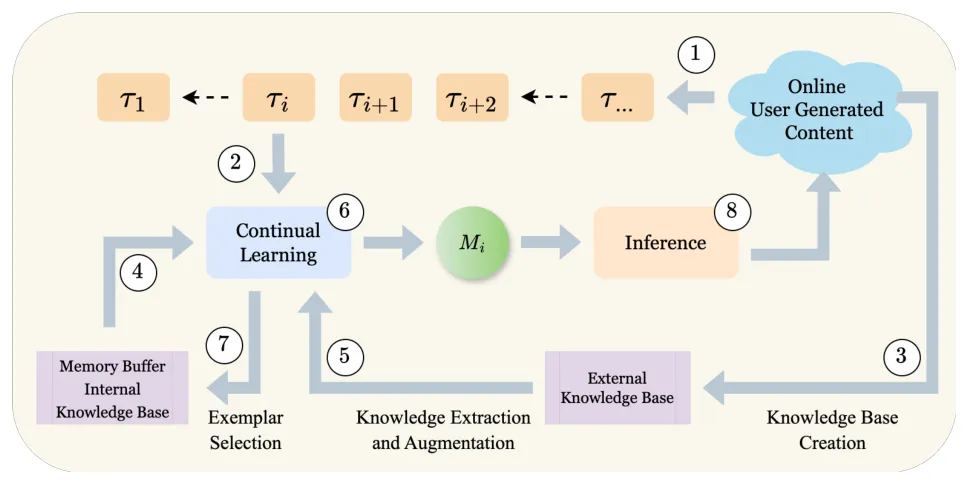 Fig. 2: Task stream → continual learning with memory buffer and external-KB augmentation → model → inference, with exemplar selection and KB refresh.Figure from Senarath et al., IEEE CogMI 2025.
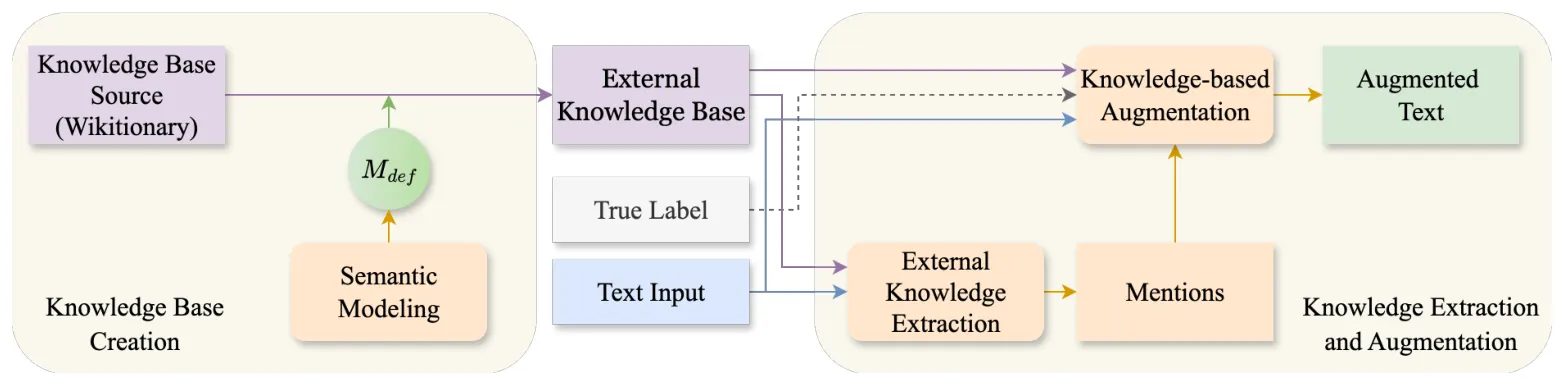 Fig. 3: Wiktionary → knowledge base; mentions extracted from input text; semantic model filters senses; knowledge-based augmentation.Figure from Senarath et al., IEEE CogMI 2025.
Key results
- Final average performance (Table III, accuracy / AUC %):
- D_B (Civil Comments): best baseline SR 65.1 / 83.5 → KR_sem 76.2 / 85.8.
- D_H (HateXplain): best baseline 16.7 / 57.2 → KR_sem 46.7 / 63.4 (KR_rnd 63.5 AUC).
- D_K (Kennedy): best baseline 27.8 / 70.5 → KR_sem 43.4 / 73.7 (KR_rnd 74.3 AUC).
- Forgetting (Table IV, accuracy-based F_A, lower is better):
- D_B: 15.9–17.3 → 3.5
- D_H: about 31 → 0.7
- D_K: about 35 → 13.4 (KR_rnd)
- Naive fine-tuning forgets up to 77.3.
- Ablation (Table V): dropping pre-learning augmentation hurts most (D_H accuracy 46.7 → 16.9). Dropping pre-selection augmentation hurts a little. Both stages help, which answers RQ2.
- KR_sem beats KR_rnd only marginally: few words in a message are hate-relevant, and semantic mode yields fewer augmentations (Fig. 5). t-SNE shows much more task-discriminative features than the baseline (Fig. 6).
- Cluster-based selection (CS) did not beat random selection, contrary to prior work.
Contributions
- An extensible framework for integrating external knowledge into continual learning for text classification (prior work used only internal knowledge).
- Addressing evolving online behavior for behavioral analytics systems.
- Extensive evaluation with ablation.
- Public release of augmented knowledge bases, models, code and processed data.
Limitations & future work
- Knowledge enters only through augmentation, not as features or constraints.
- Tasks are split only by identity group; English only.
- Wiktionary is volunteer-curated (ConceptNet and multiple knowledge bases are future work).
- Augmentation adds computational overhead.
Cite this paper
Senarath, Y., Purohit, H. (2025). Knowledge-guided Continual Learning for Behavioral Analytics Systems. The 7th IEEE International Conference on Cognitive Machine Intelligence (CogMI).
@inproceedings{Senarath2025,
  author    = {Senarath, Yasas and Purohit, Hemant},
  booktitle = {The 7th IEEE International Conference on Cognitive Machine Intelligence ({CogMI})},
  title     = {Knowledge-guided Continual Learning for Behavioral Analytics Systems},
  year      = {2025},
  keywords  = {Conference,first,Continual},
  url       = {https://ieeexplore.ieee.org/document/11417061}
}