Violence-Inducing Behavior Prevention in Social-Cyber Space
A project paper describing SOCYTI, a Research Council of Norway project (Western Norway Research Institute and GMU). It aims to give local community services real-time, multilingual (including Norwegian) and multimodal detection of violence-inducing online behaviors such as hate speech, using knowledge-base-driven augmentation to make detectors robust across targeted identity groups.
Online hate erodes community resilience; Norway lacks tools
Sparse, monolingual labels; poor generalization across target identities; multimodality
Problem
Hate speech, radicalization and polarization harm community resilience, a community’s ability to cope with disasters together. Existing resilience indices (FEMA, UNISDR, EU Resiloc) ignore dynamic social-atmosphere risks. The paper lists four challenges:
- Human-behavior indicators are missing from resilience models.
- Social cybersecurity has few studies, and the definitions of malicious behavior are fragmented.
- Labelled data is sparse (≈7% malicious) and English-centric; there is no Norwegian dataset, and models do not generalize across target identities.
- Malicious content is increasingly multimodal.
Approach (planned and ongoing)
- Three objectives:
- Characterize violence-inducing behaviors that harm resilience, and extend resilience indices.
- Infer them from multimodal, multilingual posts while respecting privacy.
- Build a real-time detection system for proactive intervention.
- Stakeholder-driven (Fig. 1): social scientists ran questionnaires and interviews to define scenarios, a community resilience index and an ontology of violence-inducing behavior.
- Data: Norwegian tweets collected with Hurtlex hate keywords, labelled hateful or not by manual review plus LLM predictions.
- System (Fig. 2): hate-speech detection as the foundation.
- Identity-term augmentation with WordNet synonyms to cover under-represented target groups.
- A custom knowledge base that extends WordNet using LLM-assisted mining.
- Open Multilingual WordNet and DBpedia for cross-lingual context.
- Continual training to follow evolving discourse.
- Multimodal fusion by concatenating text and image encodings.
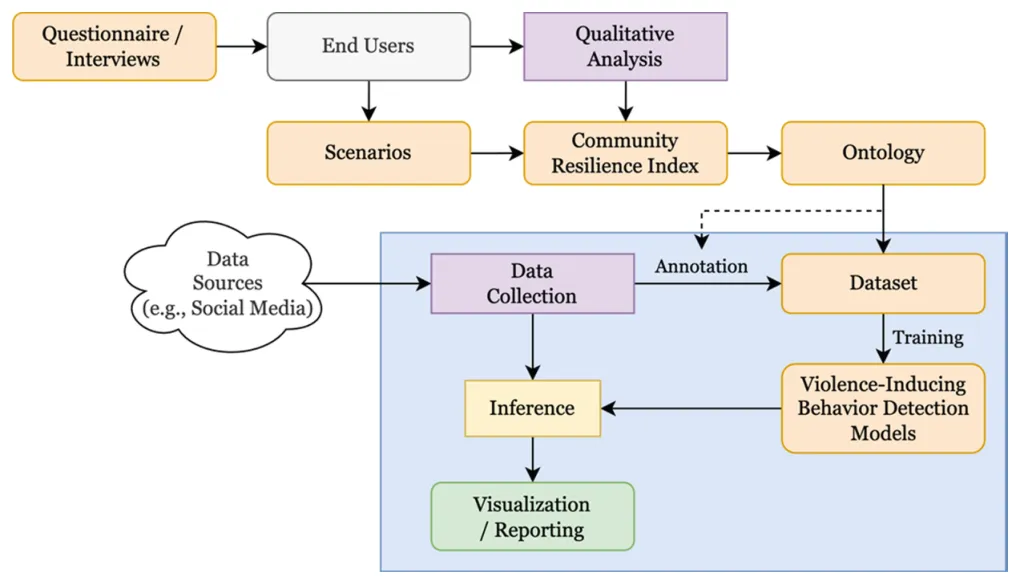 Fig. 1: Stakeholder questionnaires → scenarios, resilience index, ontology → annotated datasets → detection models → inference → visualization and reporting.Figure from Senarath et al., SAIDD (Springer) 2023.
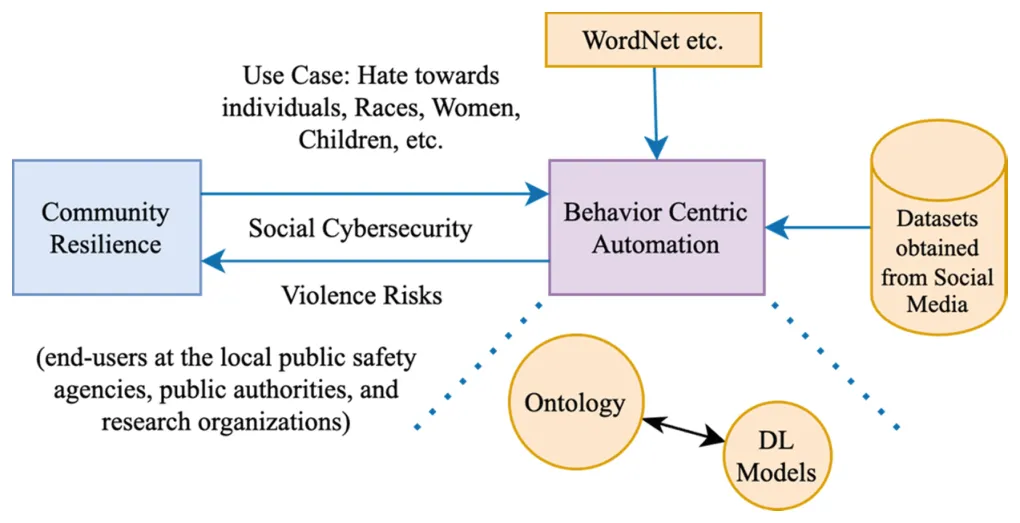 Fig. 2: Behavior-centric automation linking community resilience, social cybersecurity, external knowledge (WordNet), ontology and deep-learning models.Figure from Senarath et al., SAIDD (Springer) 2023.
Key results
- None yet. This is an ongoing-project overview with no experiments.
Contributions
- An overview of SOCYTI’s scope, objectives, background challenges and planned approach.
- A proposed hate-speech detection system as the basis for detecting violence-inducing behavior.
Cite this paper
Senarath, Y., Purohit, H., Akerkar, R. (2023). Violence-Inducing Behavior Prevention in Social-Cyber Space. International Symposium on AI, Data and Digitalization, 151–159.
@inproceedings{Senarath2023a,
  author       = {Senarath, Yasas and Purohit, Hemant and Akerkar, Rajendra},
  booktitle    = {International Symposium on AI, Data and Digitalization},
  title        = {Violence-Inducing Behavior Prevention in Social-Cyber Space},
  year         = {2023},
  organization = {Springer Nature Switzerland Cham},
  pages        = {151--159},
  keywords     = {Workshop,first,Social},
  url          = {https://link.springer.com/chapter/10.1007/978-3-031-53770-7_10}
}