Closing the Knowledge Gap in Designing Data Annotation Interfaces for AI-powered Disaster Management Analytic Systems
Beginner annotators labeling disaster tweets disagree with experts mainly because of confusing words and hidden context. The authors built a Context interface that flags historically confusing tokens and uses an LLM to explain past expert–beginner disagreements. In a study with 13 CERT volunteers, it matched the best behavioral accuracy and was rated significantly better on perceived accuracy, efficiency and knowledge-gap reduction.
Beginner volunteer annotators mislabel disaster data compared with experts
Interface aids that expose ambiguity and hidden context
Problem
Annotation UIs usually target microtasks that anyone can do (e.g., sentiment) and rely on ground-truth labels to guide annotators. Domain-specific tasks such as disaster information filtering need institutional knowledge that beginners lack. Few works study how annotation UI design can close the knowledge gap between beginners and experts on objective tasks.
Approach
S1: Formative study (8 participants: 4 experts, 4 CERT beginners; p.3–5)
- Expert interviews about workflow, training challenges and the knowledge gap.
- Hurricane Ian tweets filtered with 475 expert-verified keywords (seeded with ChatGPT) gave 4,000 tweets. Each beginner labeled 1,000 as Transportation Means (TM), Damaged Infrastructure (DI) or Irrelevant (IR).
- Expert disagreement analysis over 909 disagreements: expert correct ≈51% (459), beginner correct ≈43% (392), neither ≈6% (58).
- Retrospective interviews found two main causes: lack of contextual knowledge (6 participants) and missing visual or supplementary cues (5 participants).
Three interfaces (Fig. 1; p.6–8)
- Highlight (baseline): colors the 2 most relevant and 2 least relevant tokens using nPMI computed on agreement data, plus expert keyword lists.
- Reasoning (baseline): an LLM generates Why / Why Not explanations from the tweet plus the expert label definition, then selects concise sentences in a second prompt.
- Context (proposed): (1) flags ambiguous tokens with an ambiguity measure AM ∈ [0.5, 1], where AM ≤ 0.7 counts as ambiguous, min frequency is 3 and the top 3 are shown; (2) an LLM explains the reason for past annotators’ disagreement from their feedback (prompts in Figs. 3–4).
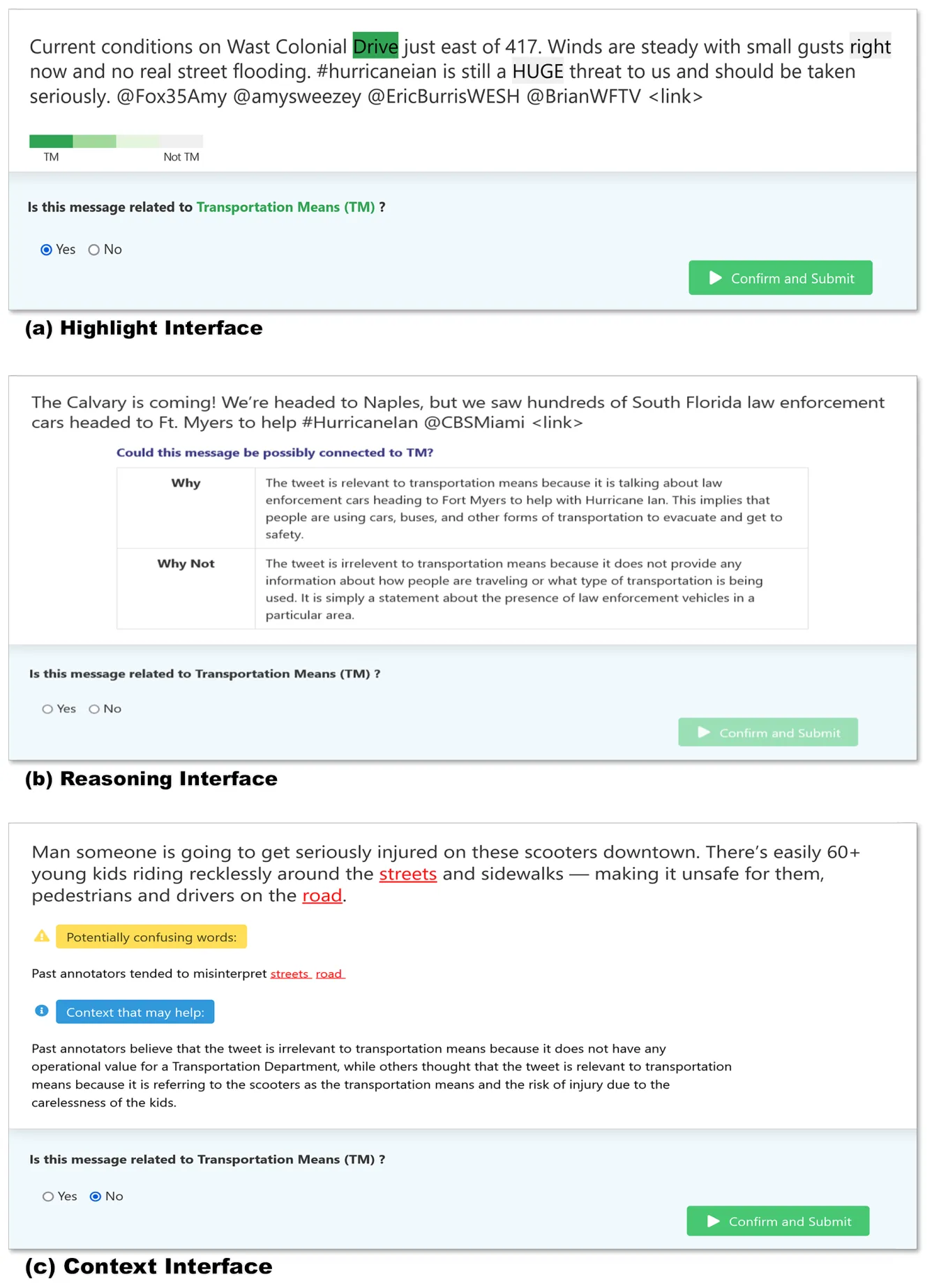 Fig. 1: (a) Highlight, (b) Reasoning (LLM Why / Why Not), (c) Context (confusing-word hints plus hidden-context explanation).Figure from Ara et al., ACM IUI 2024.
S2: Summative study
- 13 new CERT beginners (about 3.5 years of experience on average); within-subject design with Latin-square counterbalancing.
- 459 disagreement tweets, stratified into 3 sets of 40 (balanced TM/DI and FP/FN), so each participant labeled 120 tweets.
- Measures: behavioral accuracy and efficiency; attitudinal accuracy, efficiency and knowledge-gap perception (1–7 Likert scale).
Key results (scenario S1, all data; Fig. 2)
| Metric | Highlight | Reasoning | Context |
|---|---|---|---|
| Behavioral accuracy (mean) | 0.57 | 0.54 | 0.57 (not significant) |
| Completion time, 40 tweets (min) | 16.59 | 25.23 | 23.05 |
| Perceived accuracy (1–7) | 3.08 | 3.77 | 4.54 (significant) |
| Perceived efficiency (1–7) | 3.54 | 3.15 | 4.69 (p < 0.04) |
| Knowledge-gap perception (1–7) | 3.23 | 4.31 | 5.54 (p < 0.03) |
- No significant behavioral accuracy differences in any scenario. After filtering accidental clicks, Context had the highest mean (0.58) and the best minimum and maximum accuracy.
- Highlight was significantly faster than both Reasoning (p < 0.05) and Context (p < 0.03).
- In the per-question chi-square analysis, Context beat both other designs on 13 of 40 questions, 7 of them significantly (p < 0.04).
- Insight: users perceive Context as most accurate and efficient even though Highlight is faster, so behavioral and attitudinal metrics diverge.
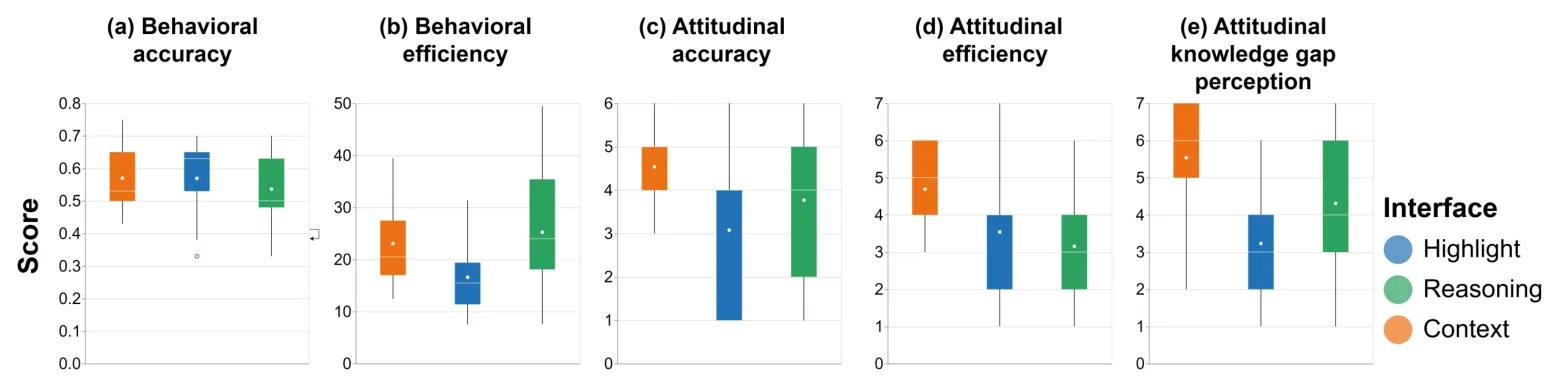 Fig. 2: Box plots for (a) behavioral accuracy, (b) completion time, (c) perceived accuracy, (d) perceived efficiency, (e) knowledge-gap perception.Figure from Ara et al., ACM IUI 2024.
Contributions
- Empirical understanding of the beginner–expert knowledge gap in disaster-data annotation, with confusing words and hidden context as its main causes.
- A novel Context interface design built on those two causes.
- A controlled experimental study (S2) of its effect.
- Design implications: multi-step workflows, extension to images and video, feedback loops, multimodal ambiguity detection.
Limitations
- The same dataset was used both for testing and for generating the context aids.
- Only one event (Hurricane Ian); ground truth from a single expert; the expert/beginner split may hide variability.
- Small sample (13 participants). LLM explanations can be verbose and may not follow label definitions.
Cite this paper
Ara, Z., Salemi, H., Hong, S. R., Senarath, Y., Peterson, S., Hughes, A. L., Purohit, H. (2024). Closing the Knowledge Gap in Designing Data Annotation Interfaces for AI-Powered Disaster Management Analytic Systems. Proceedings of the 29th International Conference on Intelligent User Interfaces, 405–418.
@inproceedings{Ara2024,
  author    = {Ara, Zinat and Salemi, Hossein and Hong, Sungsoo Ray and Senarath, Yasas and Peterson, Steve and Hughes, Amanda Lee and Purohit, Hemant},
  booktitle = {Proceedings of the 29th International Conference on Intelligent User Interfaces},
  title     = {Closing the Knowledge Gap in Designing Data Annotation Interfaces for AI-Powered Disaster Management Analytic Systems},
  year      = {2024},
  pages     = {405--418},
  keywords  = {Conference,Collaboration},
  url       = {https://dl.acm.org/doi/10.1145/3640543.3645214}
}