Designing a Human-Centered AI Tool for Proactive Incident Detection Using Crowdsourced Data Sources to Support Emergency Response
The journal extension of CROME. It adds CROMEx, an interactive dashboard where emergency-response practitioners explore crowdsourced data, compare Pareto-optimal detection models across space/time resolutions and simulate real-time detection, then choose the model themselves. The CNN beats both Bayesian fusion and KNN: F1 41.0 vs. 19.7 (KNN) and 0.6 (BF), detecting 40% of crashes early.
Practitioners must choose and trust a detection model before deploying it
Making multi-objective model trade-offs explorable; quantifying uncertainty in crowd reports
Problem
Can crowdsourced data (Waze, social media) reveal incidents before 911 calls? The data are noisy:
- Spatial uncertainty: only about 56% of Waze reports fall in the same 1 km cell as the incident (Fig. 2a).
- Temporal uncertainty: reports come both before and after the official report (Fig. 2b).
Optimizing accuracy alone hurts localization, and practitioners need control over the trade-off. Existing tools (CitizenHelper, AIDR, Dataminr) don’t help them evaluate and select models.
Approach
- Formulation: models M(Δs, Δt) over grid resolutions; pick hyperparameters that maximize F1 while keeping resolution fine.
- CROMEx architecture (Fig. 4):
- Stream processing of Waze, traffic and weather into per-cell features: report volume, sum and mean of reliability, precipitation and congestion.
- Incident-detection modelling for many (Δs, Δt).
- Optimal model selection with ε-dominance evolutionary Pareto optimization (Algorithm 1).
- Interactive visualization.
- Models compared: CNN (2 conv layers, 256 filters of 2×2); Bayesian information fusion (BF, the earlier state of the art); KNN adapted from incident forecasting.
- Evaluation: rolling three-month train / one-month test, no temporal overlap. Metrics: F1, early-prediction ratio, average distance, average early time. CNN inference takes microseconds.
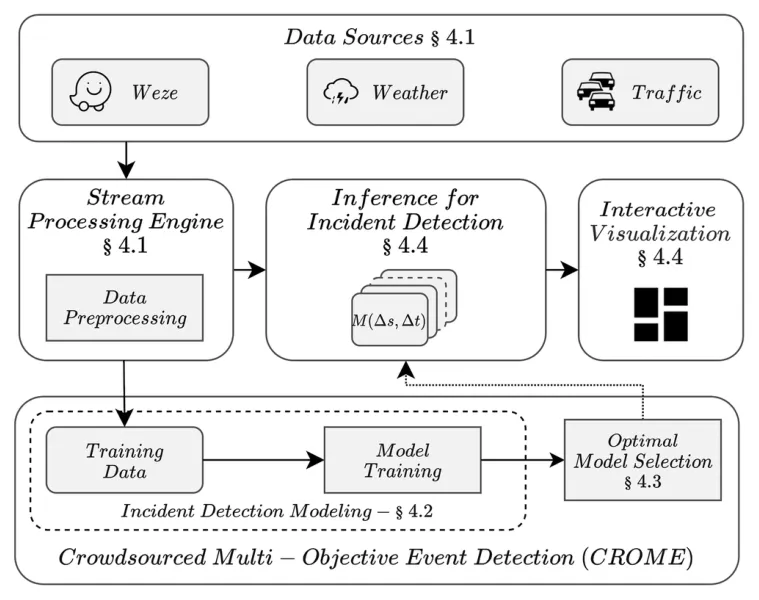 Fig. 4: Data sources → stream processing → incident detection → interactive visualization, with an offline loop for model training and optimal model selection.Figure from Senarath et al., ACM DGOV 2024.
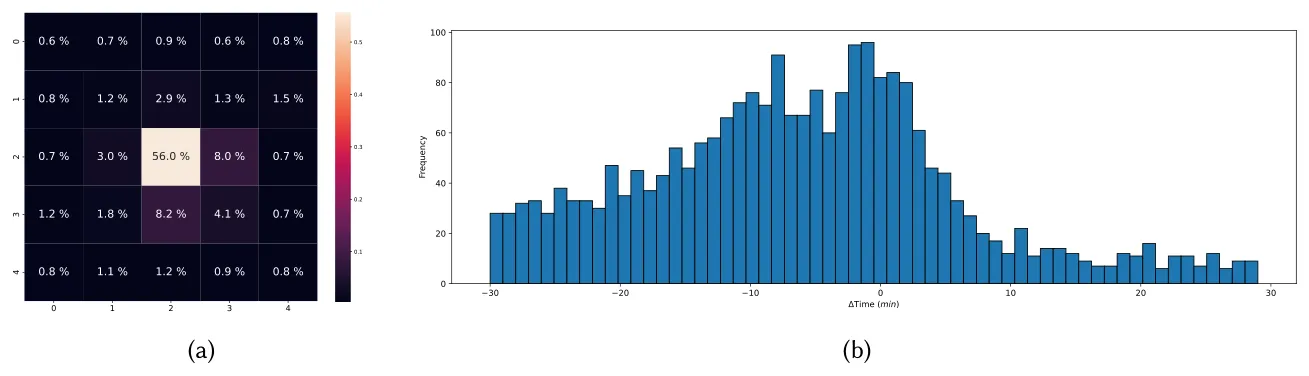 Fig. 2: (a) Share of Waze reports in each cell around the incident cell (56% in the same cell); (b) time offsets between Waze and official reports.Figure from Senarath et al., ACM DGOV 2024.
Key results
- The CNN beats BF and KNN on F1 at every resolution (Figs. 6–7). BF has high recall but terrible precision, while CNN balances the two (Fig. 8).
- Pareto front (Fig. 9): several non-dominated models are offered to practitioners.
- Table 2, best model per practitioner metric:
- Best early-prediction %: CROME F1 41.0, 40.3% early, 2.96 km, 13.9 min; KNN F1 19.7, 17.7% early; BF F1 0.6 with precision ≈ 0.
- Best distance: KNN reaches 2.05 km but misses 86.5% of incidents (recall 0.03); CROME 2.67 km at F1 16.4.
- Best early time: KNN 16.0 min at F1 11.3; CROME 14.9 min at F1 30.4.
- CROME is within 0.62 km of the best spatial localization and 1.79 min of the best temporal one, and no alternative beats it on both. BF’s alerts are about 85% false positives.
- Dashboard (Figs. 10–12): data explorer (incidents vs. Waze reports), model explorer (performance vs. resolution, optimal models highlighted), and real-time detection simulation.
Contributions
- A human-centered AI tool design (CROMEx) that extends CROME with interactive model selection for practitioners.
- A demonstration of the spatial and temporal uncertainty in crowdsourced incident reports.
- A comparison of CNN, BF and KNN on technical and practitioner-centric metrics.
- An open-source tool plus a sample dataset (the official data is proprietary).
Deployment directions & future work
- Needs real-time infrastructure, evaluation in agency simulation training, and practitioner training.
- Future work: other multi-objective algorithms and detection models.
Cite this paper
Senarath, Y., Mukhopadhyay, A., Purohit, H., Dubey, A. (2024). Designing a Human-Centered AI Tool for Proactive Incident Detection Using Crowdsourced Data Sources to Support Emergency Response. Digital Government: Research and Practice 5(1), 1–19.
@article{Senarath2024,
  author    = {Senarath, Yasas and Mukhopadhyay, Ayan and Purohit, Hemant and Dubey, Abhishek},
  journal   = {Digital Government: Research and Practice},
  title     = {Designing a Human-Centered {AI} Tool for Proactive Incident Detection Using Crowdsourced Data Sources to Support Emergency Response},
  year      = {2024},
  number    = {1},
  pages     = {1--19},
  volume    = {5},
  keywords  = {Journal,first,Crowdsourced},
  publisher = {ACM New York, NY},
  url       = {https://dl.acm.org/doi/10.1145/3633784}
}