Summarizing Social Media & News Streams for Crisis-related Events by Integrated Content-Graph Analysis: TREC-2023 CrisisFACTS Track
A TREC CrisisFACTS system that turns multi-platform crisis streams into ranked fact lists. It extracts facts (REBEL or ClausIE), filters them with KeyBERT-extended indicative terms from responders' queries, and ranks them by closeness centrality in a graph linking facts, terms and queries. The ClausIE variant (B) scores best: BERTScore F1 0.613 against NIST summaries, comprehensiveness 0.136 and redundancy score 0.507.
Responders need concise fact summaries from crisis streams
Extracting facts and ranking them by importance to responder queries
Problem
Disaster responders need concise, timely facts from noisy, multi-source streams (Twitter, Reddit, Facebook, news). Matching a query isn’t enough; a fact must matter for disaster-management information needs, which CrisisFACTS expresses as FEMA ICS-209-style queries.
Approach
System design (Fig. 1), run per event-day:
- Text to Fact: Method A uses REBEL (BART seq2seq relation extraction, 200+ relation types); Method B uses ClausIE (dependency-based open information extraction).
- Query Extender: KeyBERT expands each query’s indicative terms (Table 1).
- Filtering: PyTerrier index (DFReeKLIM weighting); top-K facts retrieved per extended term, each with a relevance score.
- Scoring (Fig. 2): a graph with fact, term and query nodes. Fact–fact and fact–query edges carry Sentence-BERT cosine similarity (pruned below 0.5); fact–term edges carry min–max-normalized retrieval scores. Closeness centrality with distance = 1 − weight gives each fact’s importance (Eqs. 1–3).
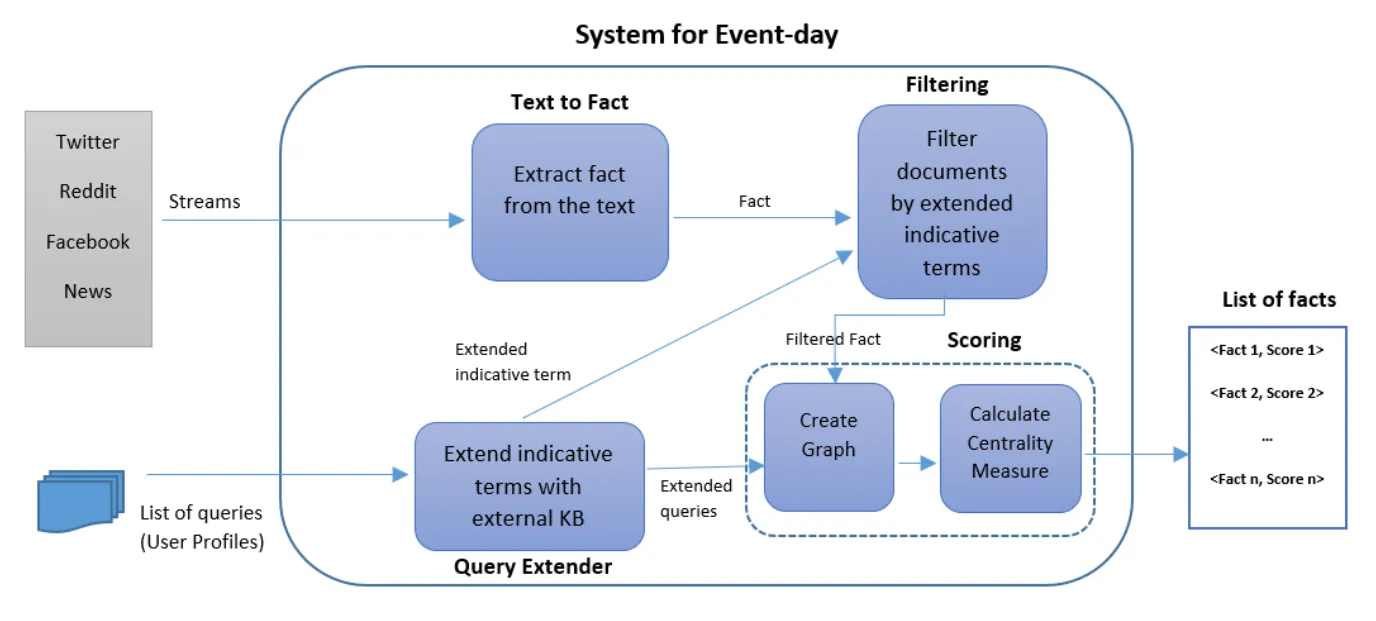 Fig. 1: Streams → text-to-fact → filtering by extended indicative terms → graph creation → centrality → ranked fact list.Figure from Salemi et al., TREC 2023.
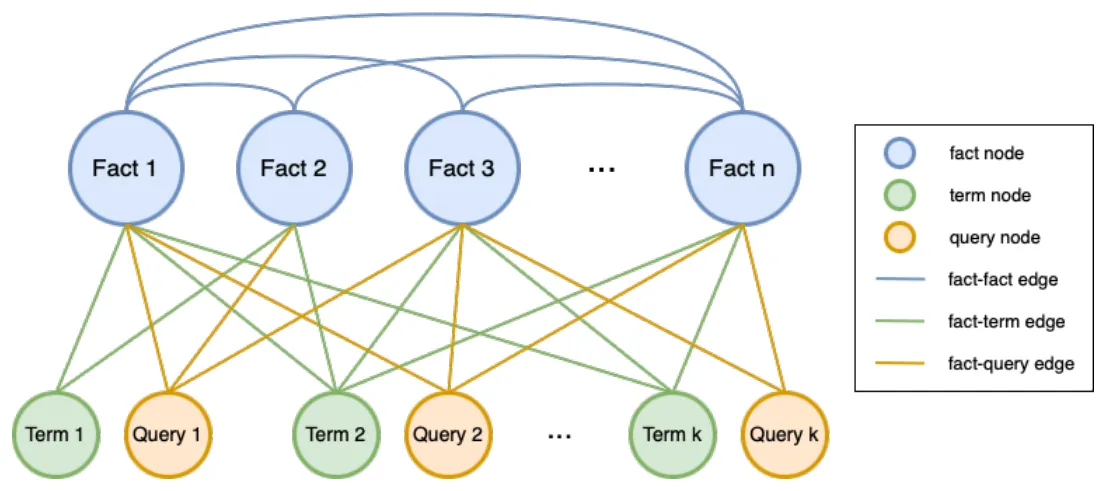 Fig. 2: Fact, term and query nodes with fact–fact, fact–term and fact–query edges.Figure from Salemi et al., TREC 2023.
Key results
- BERTScore (Table 2), F1 vs. NIST / Wikipedia summaries: Method A 0.597 / 0.445; Method B 0.613 / 0.480.
- ROUGE (Table 3), F1 vs. NIST / Wikipedia: A 0.211 / 0.039; B 0.319 / 0.028. ROUGE against Wikipedia is very low for both.
- Manual fact matching (Table 4): redundancy score (precision-based, higher is better) A 0.305 / B 0.507; comprehensiveness (recall-based) A 0.058 / B 0.136.
- Method B is better across metrics, possibly because the scoring module handles ClausIE facts better.
Contributions
- A modular system with an integrated content-graph analysis for ranking crisis facts, usable with any extractive or abstractive fact generator.
- Evaluation of two fact-extraction methods on TREC CrisisFACTS 2023.
Cite this paper
Salemi, H., Senarath, Y., Sharika, T. S., Gupta, A., Purohit, H. (2023). Summarizing Social Media & News Streams for Crisis-related Events by Integrated Content-Graph Analysis: TREC-2023 CrisisFACTS Track. The Thirty-Second Text REtrieval Conference Proceedings (TREC), 14–17.
@inproceedings{Salemi2023a,
  author    = {Salemi, Hossein and Senarath, Yasas and Sharika, Tarin Sultana and Gupta, Anuridhi and Purohit, Hemant},
  booktitle = {The Thirty-Second Text REtrieval Conference Proceedings (TREC)},
  title     = {Summarizing Social Media \& News Streams for Crisis-related Events by Integrated Content-Graph Analysis: {TREC}-2023 {CrisisFACTS} Track},
  year      = {2023},
  pages     = {14--17},
  keywords  = {Conference,Social},
  url       = {https://trec.nist.gov/pubs/trec32/papers/Human_Info_Lab.F.pdf}
}