A Comparative Study of Pre-trained Language Models to Filter Informative Code-mixed Data on Social Media during Disasters
The first Persian–English code-mixed crisis dataset: 1,758 tweets about the 2017 Iran–Iraq earthquake, labelled for informativeness. A benchmark of three pre-trained language models finds multilingual mBERT best (F1 72%), ahead of XLM-R (63%) and English-only RoBERTa (62%). The paper also lists six code-mixing patterns that users follow.
Responders must filter informative posts in bilingual regions
Code-mixed text falls outside LM pre-training
Problem
Crisis NLP filters informative posts, but code-mixing (mixing languages in one post) is barely studied there. Language models aren’t trained on code-mixed text, and its patterns depend on sociolinguistic factors.
Approach
- Collection: Twitter API through TweetKit (your Python academic Twitter client), Nov 12 – Dec 12, 2017, with Persian and English keyword lists. This gave 367k Persian and 190k English tweets, extended with replies to 593k and 329k (Table 3).
- Code-mix filtering (Fig. 1): English event dictionary applied to Persian tweets and vice versa → 3,962 code-mixed tweets → retweets, irrelevant and other-language tweets removed; hashtags split and kept; deduplication → 1,758 tweets.
- Annotation: Informative if it reports cautions, casualties, needs, rescue or volunteering, donations, damage or blocked roads (following Alam et al. and Purohit & Peterson). One annotator; 709 informative.
- Models: mBERT, XLM-R and RoBERTa with a linear head on [CLS]; AdamW, 3 epochs, learning rate 5e-5; 10-fold CV.
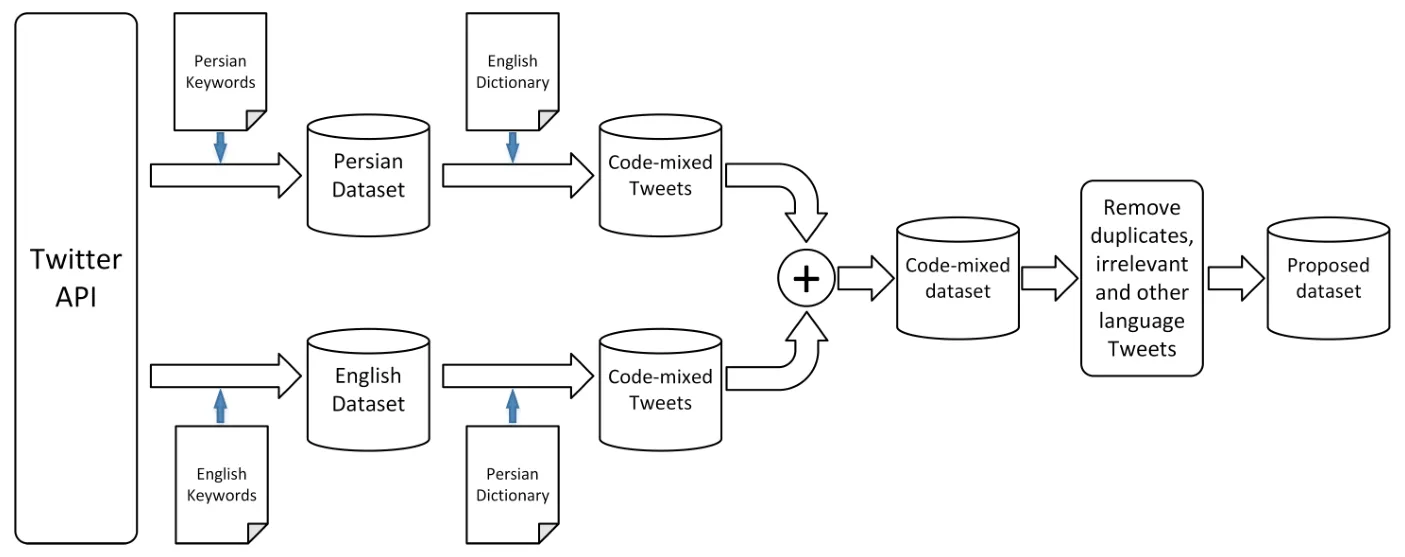 Fig. 1: Persian and English keyword collection → dictionary-based code-mix extraction → merge → cleaning → final dataset.Figure from Salemi et al., ISCRAM 2023.
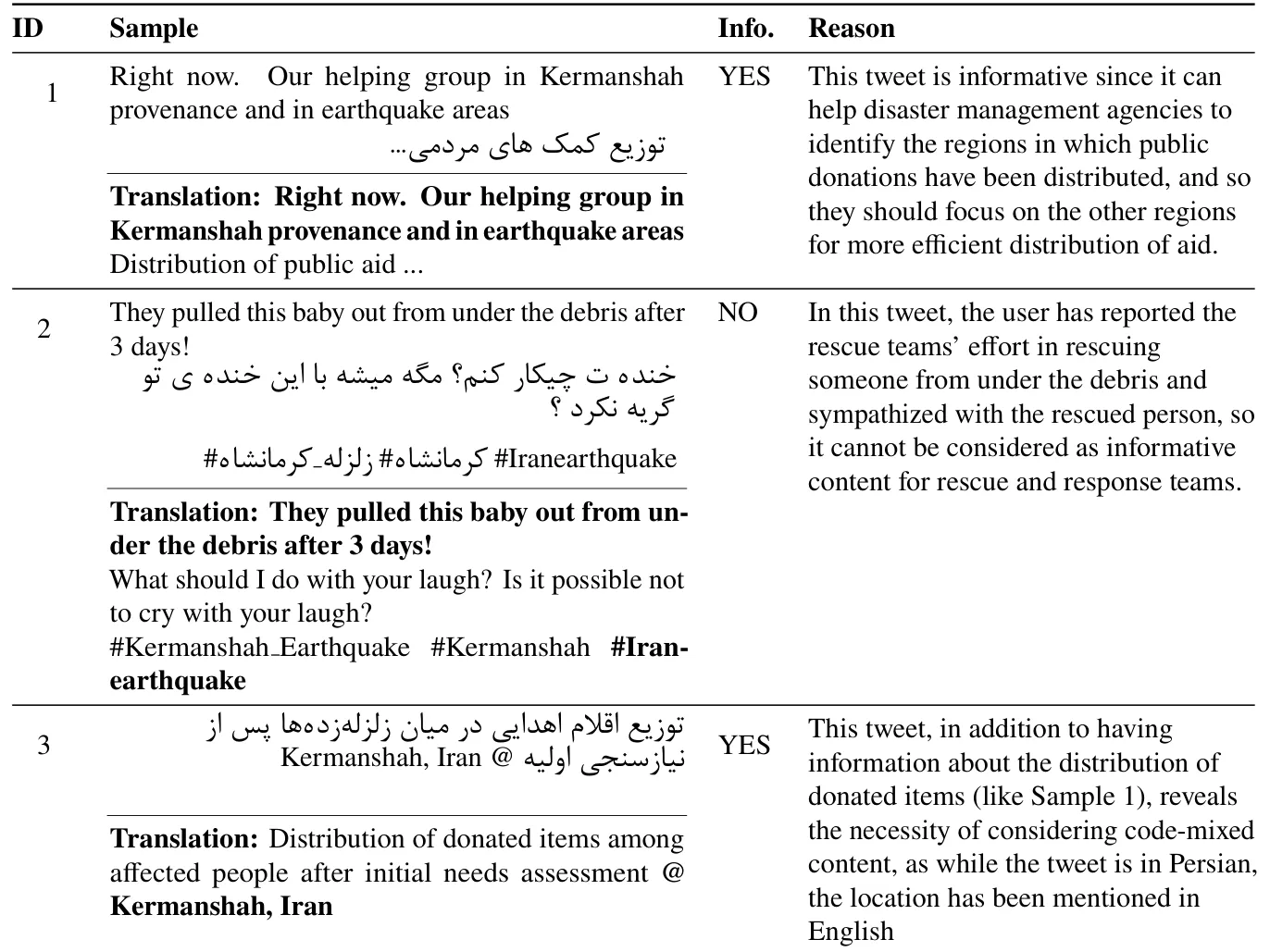 Table 1: Informative and non-informative code-mixed samples, with reasons.Figure from Salemi et al., ISCRAM 2023.
Key results
- Table 4 (mean ± std, %):
- mBERT: accuracy 81 ± 8, recall 72 ± 26, precision 71 ± 25, F1 72 ± 25.
- XLM-R: 77 / 60 / 72 / 63.
- RoBERTa: 76 / 50 / 84 / 62 (highest precision, lowest recall).
- Multilingual models beat the monolingual one, and XLM-R beats RoBERTa, its English counterpart.
- Error analysis (Table 5): RoBERTa misses Persian content with English insertions; short or partly informative tweets fool all models; mBERT relies on key tokens such as hashtags, which brings false positives; Persian half-space spelling breaks tokenization.
- Six code-mixing patterns: hashtags in the other language; hashtag-only posts; full translation; one-language summary; insertional switching (e.g., entity names); inter-sentential switching.
Contributions
- The first curated Persian–English code-mixed crisis dataset.
- Informativeness labels to help response agencies.
- A benchmark of three pre-trained language models with insights for modelling code-mixed data.
Future work
- Sociolinguistic factors (demographics, proficiency, intent); linguistic code-mixing metrics (CMI, MI); larger and augmented data.
Cite this paper
Salemi, H., Senarath, Y., Purohit, H. (2023). A Comparative Study of Pre-trained Language Models to Filter Informative Code-mixed Data on Social Media during Disasters. ISCRAM 2023 Conference Proceedings --- 20th International Conference on Information Systems for Crisis Response and Management (ISCRAM).
@inproceedings{Salemi2023,
  author    = {Salemi, Hossein and Senarath, Yasas and Purohit, Hemant},
  booktitle = {ISCRAM 2023 Conference Proceedings --- 20th International Conference on Information Systems for Crisis Response and Management (ISCRAM)},
  title     = {A Comparative Study of Pre-trained Language Models to Filter Informative Code-mixed Data on Social Media during Disasters},
  year      = {2023},
  keywords  = {Conference,Social},
  url       = {https://www.idl.iscram.org/files/salemi/2023/2576_Salemi_etal2023.pdf}
}