Efficient Detection of Multilingual Hate Speech by Using Interactive Attention Network with Minimal Human Feedback
MLIAN adapts interactive attention networks so that a simulated human's hate-target label (individual vs. group) steers attention while the model is trained on English and Spanish tweets. It reaches AUC 84.1 / F1 84.9, vs. 79.4 / 71.6 for the best LSTM baseline. Feedback on under 4% of training data (500 labels) gives significant gains. Attention maps line up with semantic frames in both languages.
Moderating hate across languages, slang and new targets
Multilingual and cross-target generalization plus interpretability with minimal feedback
Problem
Most hate-speech detectors work in one language, depend on lexicons that age quickly, miss local slang and implicit hate (e.g., “building a wall”), and fail when the target group changes (immigrants vs. women). Deep models are also opaque, so humans can’t give useful feedback.
- RQ1: does an interactive attention network with human-in-the-loop feedback improve multilingual detection?
- RQ2: does frame-guided feedback speed up convergence?
- RQ3: how much feedback is needed?
Approach
- Architecture (Fig. 2): two LSTMs over multilingual embeddings, one for the target (from human feedback) and one for the context. Mutual attention links them, and the concatenated representations go to a softmax.
- Embeddings: LASER (1024-d sentence vectors, 93 languages) or DistilmBERT (token-level).
- Feedback design, guided by frame semantics: humans supply the hate-target element (individual or group) of the frame. Here this is simulated with the HatEval target-type labels.
- Interpretability: SLING frame parsing of Spanish tweets and their English translations, compared with MLIAN attention maps with and without feedback (Figs. 3–4).
- Baselines: SVC, RF, SGD and MLP on LASER; LSTM on LASER and on DistilmBERT. 10-fold CV; accuracy, AUC and weighted F1.
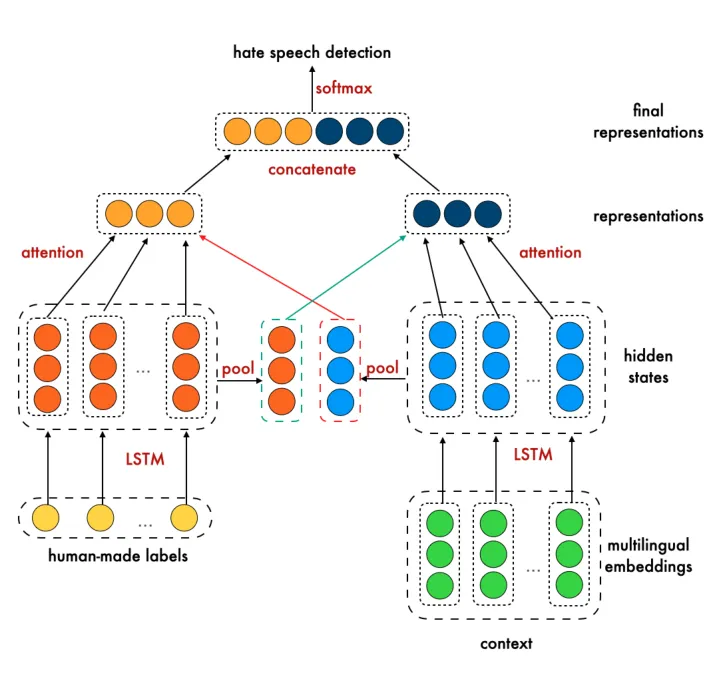 Fig. 2: Target LSTM (human-labelled hate target) and context LSTM over multilingual embeddings, with interactive attention, concatenation and softmax.Figure from Vitiugin et al., ACM WebSci 2021.
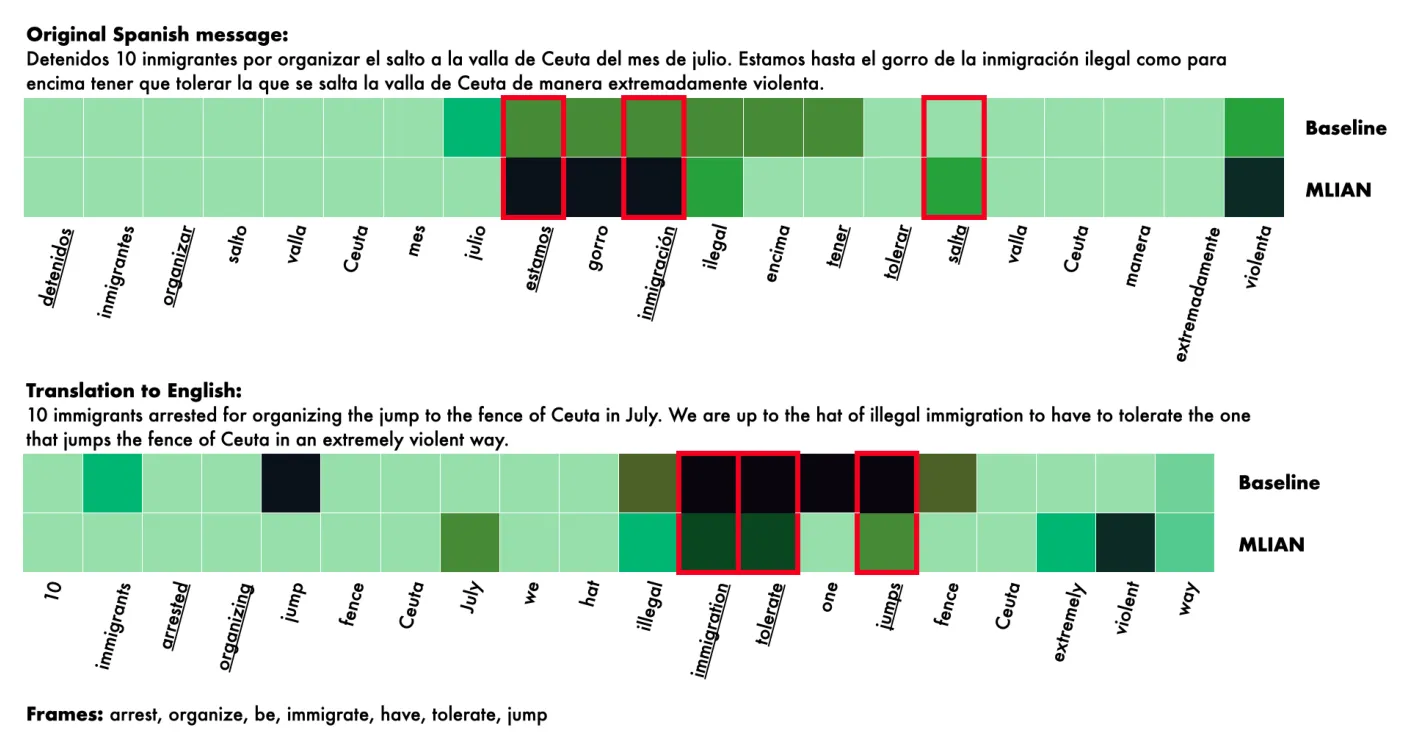 Fig. 4: Attention for a Spanish tweet and its English translation, baseline vs. MLIAN with feedback. Red boxes mark words matching SLING frames.Figure from Vitiugin et al., ACM WebSci 2021.
Key results
- Multilingual (Table 3): MLIAN+LASER reaches ACC 85.06, AUC 84.14, F1 84.94. MLIAN+DistilmBERT scores 81.24 / 79.84 / 81.00. The best baselines are LSTM+LASER (AUC 79.38, F1 71.58) and SVC+LASER (F1 71.85).
- Minimal feedback (Table 4): baseline F1 73.15 → 100 labels 74.16 → 500 labels (about 4% of training data) 77.44 (p = 0.001) → 1,000 labels 78.62.
- Cross-lingual (Table 5): EN→ES AUC 68.2 (LSTM 65.7); ES→EN AUC up to 79.0 (LSTM 68.6).
- Cross-target (Table 6): migrants→women AUC 80.3 (MLIAN+LASER); women→migrants AUC 82.7 (MLIAN+DistilmBERT); LSTM baselines reach at most about 74.
- Interpretability: with feedback, attention correlates more strongly with semantic frames, consistently across languages.
Contributions
- The MLIAN model for language-agnostic hate-speech detection.
- A principled, frame-semantics-based way to guide human feedback and to analyze model reasoning.
- Evidence that little feedback (under 4%) is enough.
- Cross-lingual and cross-target gains.
Limitations & future work
- Only two target groups and two languages.
- Human feedback is simulated with existing labels; testing with real humans is future work.
Cite this paper
Vitiugin, F., Senarath, Y., Purohit, H. (2021). Efficient Detection of Multilingual Hate Speech by Using Interactive Attention Network with Minimal Human Feedback. Proceedings of the 13th ACM Web Science Conference (WebSci), 130–138.
@inproceedings{Vitiugin2021,
  author    = {Vitiugin, Fedor and Senarath, Yasas and Purohit, Hemant},
  booktitle = {Proceedings of the 13th ACM Web Science Conference (WebSci)},
  title     = {Efficient Detection of Multilingual Hate Speech by Using Interactive Attention Network with Minimal Human Feedback},
  year      = {2021},
  pages     = {130--138},
  keywords  = {Conference,Social},
  url       = {https://dl.acm.org/doi/10.1145/3447535.3462495}
}