Evaluating Semantic Feature Representations to Efficiently Detect Hate Intent on Social Media
An empirical study combining three kinds of semantics for binary hate/offensive tweet detection: corpus-based (tf-idf), declarative knowledge (Hatebase and FrameNet) and distributional (word2vec). The hybrid representation beats tf-idf alone on two Twitter datasets and generalizes much better across datasets (F1 39.6 → 56.8 and 78.9 → 88.6).
Platforms must detect hateful intent
Representing context and word sense; generalizing across datasets
Problem
Hate intent is subtle: sarcasm, anger and hate are hard to separate, and context is hard to represent. Prior work explored many feature types but used knowledge-base features little, with no systematic study of how different semantic representations combine.
Approach
- Task: binary classification of hate or offensive vs. normal. DWMW17 (hate + offensive → hate) and FDCL18 (abusive + hateful → hate; spam + normal → normal) (Table II).
- Features:
- Corpus semantics: tf-idf with 1–3-grams (baseline M1).
- Declarative knowledge from Hatebase: offensiveness score (binned), an unambiguous flag, and bag-of-words over hateful and non-hateful definitions of each hate term.
- FrameNet: frames from the SLING parser (PropBank frames mapped to FrameNet), as frame-count vectors.
- Distributional semantics: mean of 300-d word2vec embeddings.
- Model: linear SVM (L2, C = 1.0); incremental schemes M1 → M7 add one feature group at a time; 5-fold stratified CV.
 Table I: Why context matters: hateful, implicitly offensive, and angry-but-not-hateful posts.Figure from Senarath et al., IEEE ICSC 2020.
Key results
- Best scheme M7 (all features): DWMW17 F1 96.9 (vs. M1 95.1); FDCL18 F1 78.8 (vs. 76.5) (Table III).
- Knowledge-base features (Hatebase, FrameNet) mainly raise precision: DWMW17 P 93.5 → 97.2 for M6.
- Cross-dataset generalization (Table IV): train DWMW17 → test FDCL18, F1 39.6 → 56.8; train FDCL18 → test DWMW17, F1 78.9 → 88.6. tf-idf alone does not transfer across datasets.
- Error analysis (Table V) shows the remaining failures need discourse context (e.g., the relationship between speaker and receiver).
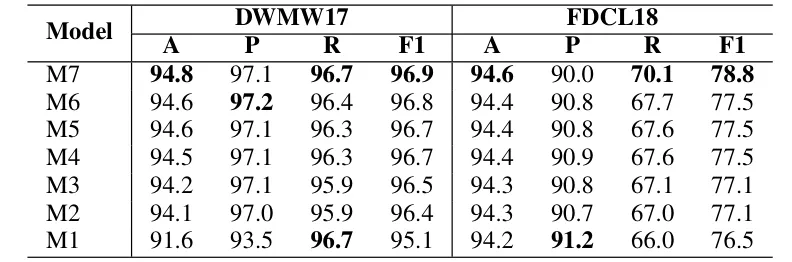 Table III: Accuracy, precision, recall and F1 for schemes M1–M7 on both datasets.Figure from Senarath et al., IEEE ICSC 2020.
Contributions
- An extensive empirical evaluation of diverse semantic feature representations (corpus, knowledge-base, distributional) for hate speech detection.
- Evidence that combining them improves performance (claimed absolute F1 gain of up to 3.0%).
Limitations & future work
- Polysemy is only partly handled; contextual word-sense disambiguation is needed.
- English only, so multilingual extension is future work. Discourse features (speaker–receiver relationship) are also future work.
Cite this paper
Senarath, Y., Purohit, H. (2020). Evaluating Semantic Feature Representations to Efficiently Detect Hate Intent on Social Media. 2020 IEEE 14th International Conference on Semantic Computing (ICSC), 199–202.
@inproceedings{Senarath2020a,
  author       = {Senarath, Yasas and Purohit, Hemant},
  booktitle    = {2020 IEEE 14th International Conference on Semantic Computing (ICSC)},
  title        = {Evaluating Semantic Feature Representations to Efficiently Detect Hate Intent on Social Media},
  year         = {2020},
  organization = {IEEE},
  pages        = {199--202},
  keywords     = {Conference,first,Social},
  url          = {https://ieeexplore.ieee.org/document/9031482/}
}