ACTSEA: Annotated Corpus for Tamil & Sinhala Emotion Analysis
The first emotion corpus for Tamil and Sinhala: 600k Tamil and 318k Sinhala tweets, collected semi-automatically with emotion keywords expanded by a morphological generator (400–900 inflected forms per emotion). A 3,000-tweet annotated sample shows strong inter-annotator agreement for Tamil (κ 0.76–0.91) and moderate agreement for Sinhala (κ 0.55–0.72).
No emotion-analysis resources for Tamil and Sinhala
Scalable corpus creation for morphologically rich, low-resource languages
Problem
Tamil and Sinhala, spoken by about 100 million people, had no annotated emotion corpora. Manual corpus creation is too expensive for low-resource languages. Existing semi-automatic methods (Mohammad et al.) don’t handle morphological richness: English needs 60–100 keywords per emotion, while these languages need hundreds of inflections.
Approach
- Keywords: linguists chose stem emotion keywords for six emotions (anger, disgust, fear, joy, sadness, surprise). A morphological generator expanded them, for example anger from 70 stems to 863 inflected keywords (Table I).
- Collection (Fig. 1): month-by-month scraping of all 2018 tweets matching the keywords, followed by deduplication and cleaning (hashtags, mentions and URLs removed, other-language sentences dropped).
- Annotation: a sampling approach with native-speaker annotators. Labels are Correctly Classified, Misclassified (emotional but a different emotion), Objective (no emotion) and Not Applicable. Two annotators plus a validator (Tables II–IV).
- Sample: 300 tweets per emotion for Tamil and 200 for Sinhala, 3,000 in total.
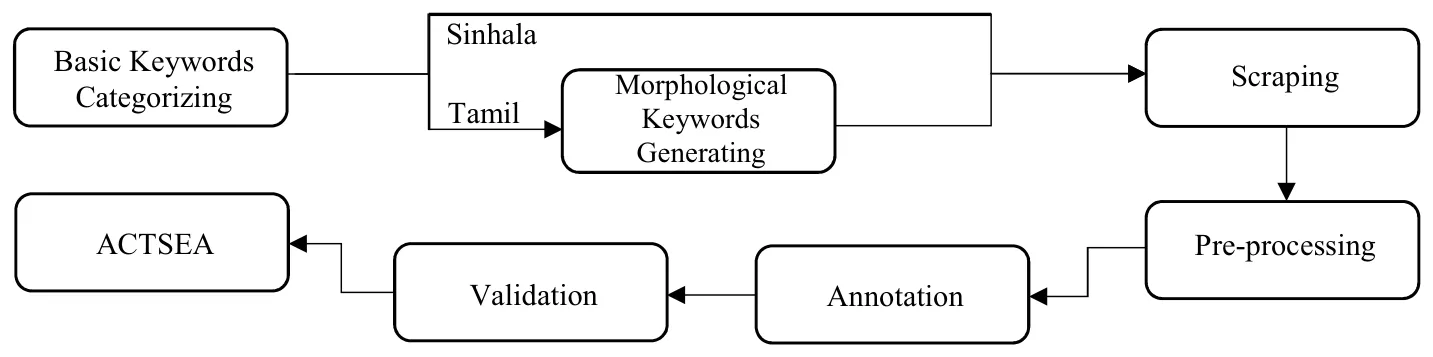 Fig. 1: Basic keyword categorization → morphological keyword generation (Sinhala/Tamil) → scraping → preprocessing → annotation → validation → ACTSEA.Figure from Jenarthanan et al., MERCon 2019.
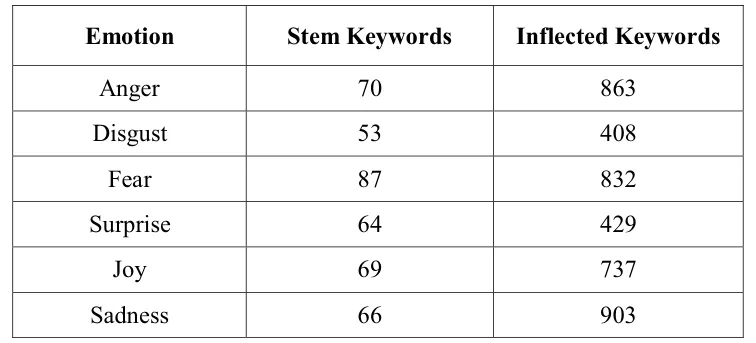 Table I: Stem vs. inflected keywords per emotion, showing the effect of morphology.Figure from Jenarthanan et al., MERCon 2019.
Key results
- Corpus size: 600,280 Tamil and 318,308 Sinhala tweets, the largest collection for these languages at the time.
- Annotated sample (Table V): 543 objective and 945 uncertain tweets removed. The paper reports that 1,962 correctly classified and misclassified tweets remain.
- Agreement: Cohen’s κ for Tamil is 0.76–0.91; for Sinhala it is 0.55–0.72, with sadness lowest (0.55) (Table V).
- Purity: on average 25.45% of keyword-collected tweets are correctly classified. For Sinhala, misclassified tweets outnumber correct ones, likely because of negation, news headlines and mixed emotions.
Contributions
- A language- and topic-independent semi-automatic corpus generator.
- Primary emotion keywords and their morphological variants for Tamil and Sinhala.
- A morphological keyword generator.
- ACTSEA, the first public emotion-annotated corpus for Tamil and Sinhala.
Cite this paper
Jenarthanan, R., Senarath, Y., Thayasivam, U. (2019). ACTSEA: Annotated Corpus for Tamil & Sinhala Emotion Analysis. 2019 Moratuwa Engineering Research Conference (MERCon), 49–53.
@inproceedings{Jenarthanan2019,
  author       = {Jenarthanan, Rajenthiran and Senarath, Yasas and Thayasivam, Uthayasanker},
  booktitle    = {2019 Moratuwa Engineering Research Conference (MERCon)},
  title        = {{ACTSEA}: Annotated Corpus for Tamil \& Sinhala Emotion Analysis},
  year         = {2019},
  organization = {IEEE},
  pages        = {49--53},
  keywords     = {Conference,Opinion},
  url          = {https://ieeexplore.ieee.org/document/8818760/}
}