Evaluating the Relevance of UMLS Knowledge Base for Public Health Informatics during Disasters
An exploratory study of how well the UMLS biomedical knowledge base covers disaster-health terminology. Of 24 expert-chosen terms, only 54% get even one exact concept match and 33% get none. Only 16% of the 492 retrieved concepts are relevant, the rest being noise such as "coordination" → Cerebellar Ataxia. The authors conclude UMLS needs extending before it can structure disaster social-media data.
Public-health agencies need a standard vocabulary for disaster-health information
Measuring knowledge-base coverage and sense alignment for domain terms
Problem
To extract public-health knowledge from social media during disasters, systems need a shared vocabulary aligned with the domain. UMLS is comprehensive for clinical text, but laypeople, responders and clinicians use different terms. Disaster-specific concepts (WASH, unaccompanied minors, complex emergencies) may be missing or ambiguous (Table 1).
Approach
- Terms: 24 disaster-health terms sampled by a public-health and emergency-medicine expert from disaster manuals, guidebooks and coded Haiti 2010 situation reports.
- Retrieval (Fig. 1): the UMLS REST API search endpoint, restricted to six vocabularies (SNOMEDCT_US, MSH, HL7V3.0, WHO, LNC, MEDLINEPLUS), then the content endpoint for each concept’s details and its first four atoms (Table 2).
- Annotation: a medical doctor working with humanitarian organizations labelled each CUI as Exact, Partial (relevant or irrelevant) or Missing.
- Analysis by term, match type and source vocabulary.
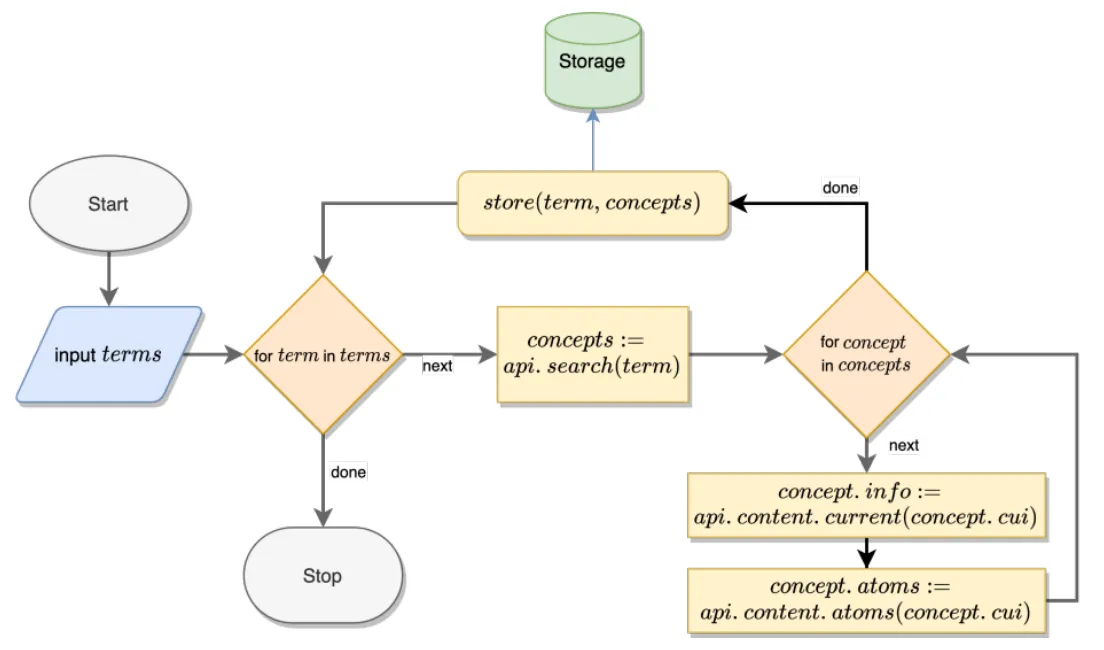 Fig. 1: For each term, search the UMLS API, then fetch each concept’s info and atoms and store them.Figure from Senarath et al., ISCRAM 2021.
Key results
- 492 CUIs retrieved for 24 terms.
- 13 terms (54%) have at least one exact match (Table 4): children, community health centers, coordination, displacement, evacuation, famine, hurricanes, malnutrition, protection, refugees, shelter, tornadoes, vulnerable populations.
- Only 79 of 492 CUIs (16%) are exact matches. Most are partial and irrelevant (Fig. 3), e.g. coordination → Cerebellar Ataxia, displacement → Hip Dislocation, evacuation → Incision and drainage, protection → Foot protection (Table 5).
- 8 terms (33%) have no concept at all: WASH, road access, medical logistics/distribution, Emergency Operations Center, damaged health infrastructure, complex emergency, burial practices, acute respiratory illness.
- By vocabulary (Fig. 4): LNC has the widest coverage, but vocabularies overlap little, so no single one is enough.
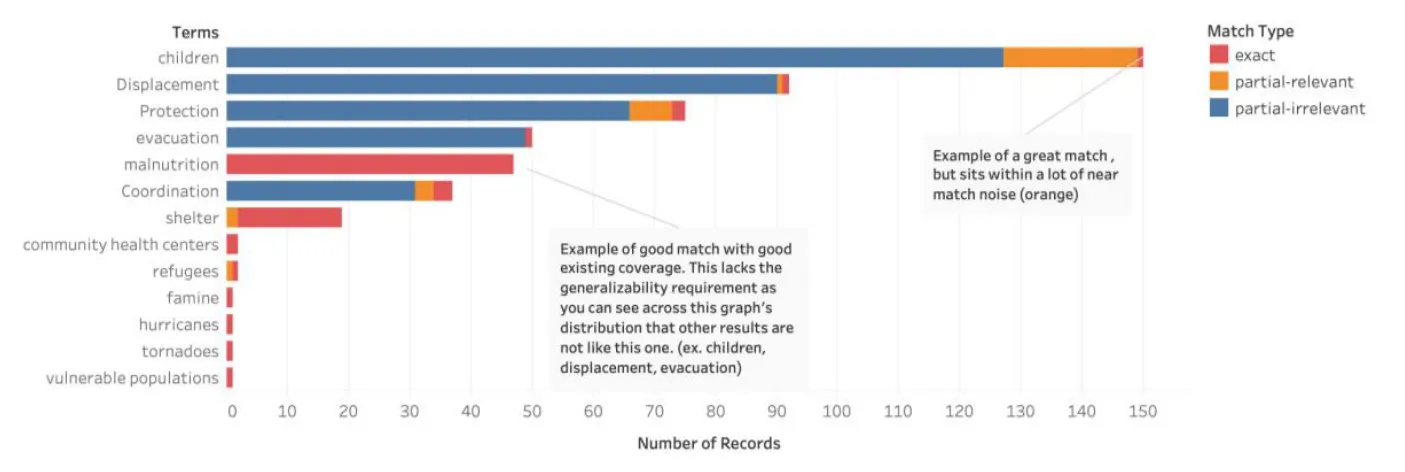 Fig. 3: Exact, partial-relevant and partial-irrelevant returns per term (N = 492).Figure from Senarath et al., ISCRAM 2021.
Contributions
- A quantitative assessment of UMLS coverage of disaster-health terminology.
- Evidence that UMLS ontologies and knowledge bases need extending, and that NLP beyond lexical matching is needed for disaster informatics.
Limitations & future work
- Small term set (24), because one expert reviewed every result. Crowdsourced relevance judgments are planned.
- Retrieval limited to the REST API; NLP methods could improve recall.
- Terms come from literature; social-media terms (e.g., from COVID-19) are future work.
Cite this paper
Senarath, Y., Chan, J., Purohit, H., Uzuner, O. (2021). Evaluating the Relevance of UMLS Knowledge Base for Public Health Informatics during Disasters. ISCRAM 2021 Conference Proceedings --- 18th International Conference on Information Systems for Crisis Response and Management (ISCRAM).
@inproceedings{Senarath2021a,
  author    = {Senarath, Yasas and Chan, Jennifer and Purohit, Hemant and Uzuner, Ozlem},
  booktitle = {ISCRAM 2021 Conference Proceedings --- 18th International Conference on Information Systems for Crisis Response and Management (ISCRAM)},
  title     = {Evaluating the Relevance of {UMLS} Knowledge Base for Public Health Informatics during Disasters},
  year      = {2021},
  keywords  = {Conference,first,Social},
  url       = {https://www.idl.iscram.org/files/yasassenarath/2021/2317_YasasSenarath_etal2021.pdf}
}