Multi-domain Aspect Extraction using Support Vector Machines
A one-vs-rest linear SVM with a careful preprocessing pipeline (including context-sensitive spell correction) and new features (mean word2vec embeddings, per-phrase head nouns, named entities) beats the best SemEval-2016 Task 5 system on both domains: 74.18 F1 on restaurants and 52.21 on laptops (vs. 73.03 / 51.94).
Businesses and consumers need to know which aspects (food, service, price) reviews discuss
Multi-label aspect classification with many classes (81) and implicit aspects in noisy text
Problem
Aspect-based sentiment analysis has to find every aspect category in a review sentence, including implicit ones, across domains with many classes (81 for laptops). The top SemEval-2016 system was a complex CNN + feed-forward hybrid. The question: can a simple SVM with well-chosen features beat it?
Approach
- Preprocessing (Fig. 1): remove HTML, fix encoding, normalize elongated words (“sooooo”), apply context-sensitive spell correction (Bing Spell Check), expand contractions, map symbols to words, add a price-indicator token, remove articles.
- Features: lemmatized bag of words (CoreNLP); custom food, drink and laptop word lists; opinion-target annotations; per-category tf-idf frequent words; price and ”!” presence; last five words; plus three new ones:
- NER tags as direct features;
- head nouns for every phrase (rightmost noun), not one per sentence, so several aspects can be captured;
- mean word2vec embedding (Google News).
- Classifier: one-vs-rest linear SVM (12 classifiers for restaurants, 81 for laptops), tuned by cross-validation.
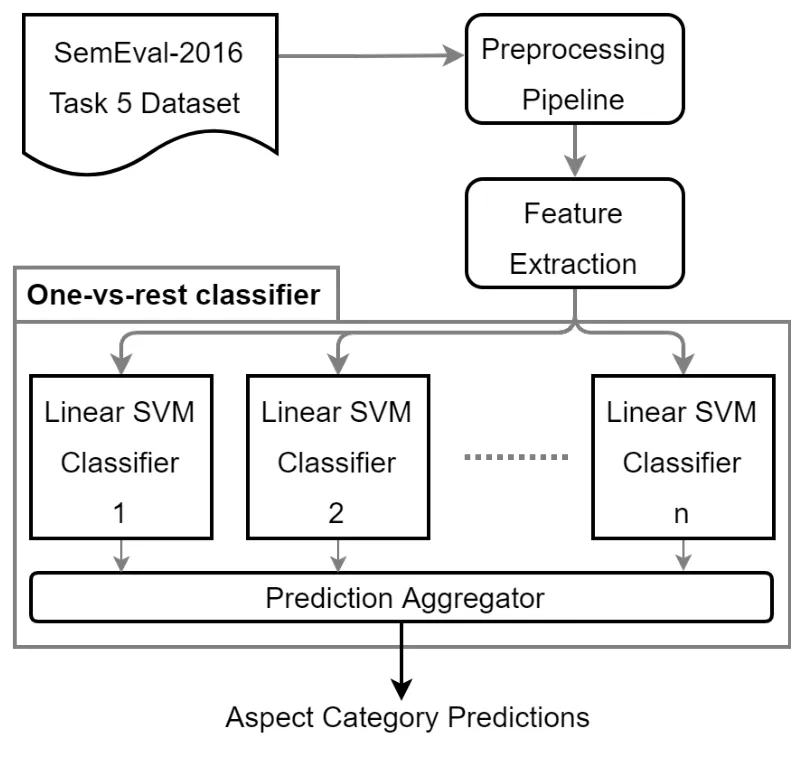 Fig. 1: SemEval-2016 data → preprocessing → feature extraction → one-vs-rest linear SVMs → prediction aggregation → aspect predictions.Figure from Jihan et al., ROCLING 2017.
Key results
- Ablation (Table 1): F1 for restaurants / laptops climbs from 60.34 / 37.31 (lemmas only) through the features. Mean embeddings give the biggest single jump on restaurants (68.5 → 72.03). Preprocessing adds the final gain to 74.18 / 52.21.
- Beats the SemEval-2016 best (NLANGP, 73.03 / 51.94) in both domains.
- Context-sensitive vs. isolated-word spell correction: 72.88 → 74.18 F1 on restaurants.
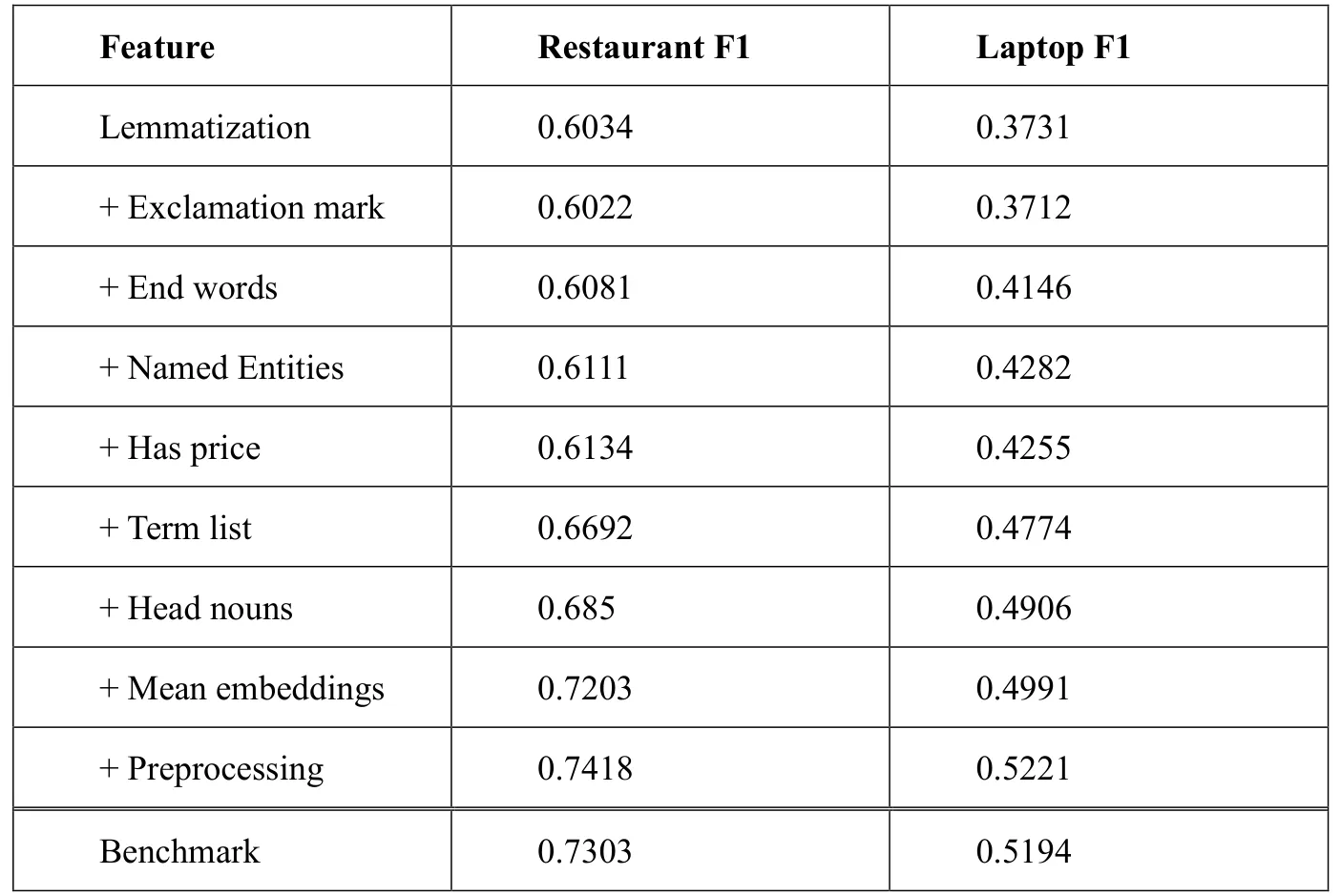 Table 1: Cumulative feature ablation vs. the SemEval-2016 benchmark.Figure from Jihan et al., ROCLING 2017.
Contributions
- An effective SVM aspect classifier that beats the state of the art.
- A preprocessing pipeline with context-sensitive spell correction (not previously used for this task).
- New features (mean embeddings, per-phrase head nouns, NER as features). All features except the custom word lists adapt automatically to new domains.
Cite this paper
Jihan, N., Senarath, Y., Tennekoon, D., Wickramarathne, M., Ranathunga, S. (2017). Multi-domain Aspect Extraction using Support Vector Machines. Proceedings of the 29th Conference on Computational Linguistics and Speech Processing (ROCLING), 308–322.
@inproceedings{Jihan2017,
  author    = {Jihan, Nadheesh and Senarath, Yasas and Tennekoon, Dulanjaya and Wickramarathne, Mithila and Ranathunga, Surangika},
  booktitle = {Proceedings of the 29th Conference on Computational Linguistics and Speech Processing ({ROCLING})},
  title     = {Multi-domain Aspect Extraction using Support Vector Machines},
  year      = {2017},
  pages     = {308--322},
  keywords  = {Conference,Opinion},
  url       = {https://aclanthology.org/O17-1029.pdf}
}